



The recent failure of Cobb County’s voter referendum for the Mobility Special Purpose Local Option Sales Tax (MSPLOST) – a 30-year penny sales tax to expand the county’s bus and shuttle system – has left city officials and transit advocates contemplating the path forward.
Although there is a demand for enhanced mass transit, Cobb voters resoundingly rejected the MSPLOST by 62% to 38%, whether due to opposition to increased taxes, unawareness about what the proposal would deliver or misinformation.
The MSPLOST — designed to fund $10.3 billion worth of specific transit improvements from expanded rapid bus transit routes to local on-demand shuttle service — faced a strong headwind of public skepticism.
“There’s been a lot of misinformation about the MSPLOST,” said Matt Stigall, executive director of Cobb 4 Transit, during a webinar organized by the local citizens’ group A Better Cobb. “Some people said, ‘We don’t know where the money would go, and there’s no project list,’ but there is very clearly a project list.”
Stigall highlighted a pattern of resistance in some parts of the county, where long-time suburban residents actively oppose change, especially around expanding transit and allowing homeowners to add accessory dwelling units (ADUs), such as backyard tiny homes, to their property.
“There’s people who’ve lived there for a while, and they don’t want to see their neighborhoods change. Anytime we propose anything, they’ll fight back against it, and they’ll bring their neighbors to fight back against it, creating this echo chamber of misinformation,” said A Better Cobb member Sam Foster.
Stigall emphasized that rising housing costs have made Cobb residents wary of additional taxes like the MSPLOST, even if they might benefit from improved transit. However, he added, expanding public transit can reduce people’s living expenses by making a car unnecessary, particularly for more remote parts of the county where housing is cheaper.
But without communicating clear links between transit and housing affordability, the transit referendum’s potential benefits went unrecognized by voters, he concluded. Housing, transportation, and public safety are intertwined, Stigall said. “They’re all connected, whether it’s the land use and zoning or how we get around without a car, or how walkable our neighborhoods are.”

Who’s going to pay for it?
Data from the Atlanta Regional Commission’s annual Metro Atlanta Speaks survey highlights a contradiction: The idea of public transit expansion is appealing to metro residents—but when paired with an additional sales tax, enthusiasm wanes sharply.
In metro Atlanta overall, 66% of residents say improved transit is very important to them, but only 13.2% say they’d strongly agree to tax themselves to fund it. Those figures hold true for Cobb: 66.2% of residents strongly support public transit, but only 13.5% said they’d increase their taxes for it.
“People want public transit,” said Stigall, “but then when you ask them who’s going to pay for it, suddenly everyone doesn’t want to pitch in on that. It’s an interesting, difficult dichotomy that we have to face.”

New microtransit pilot for South Cobb
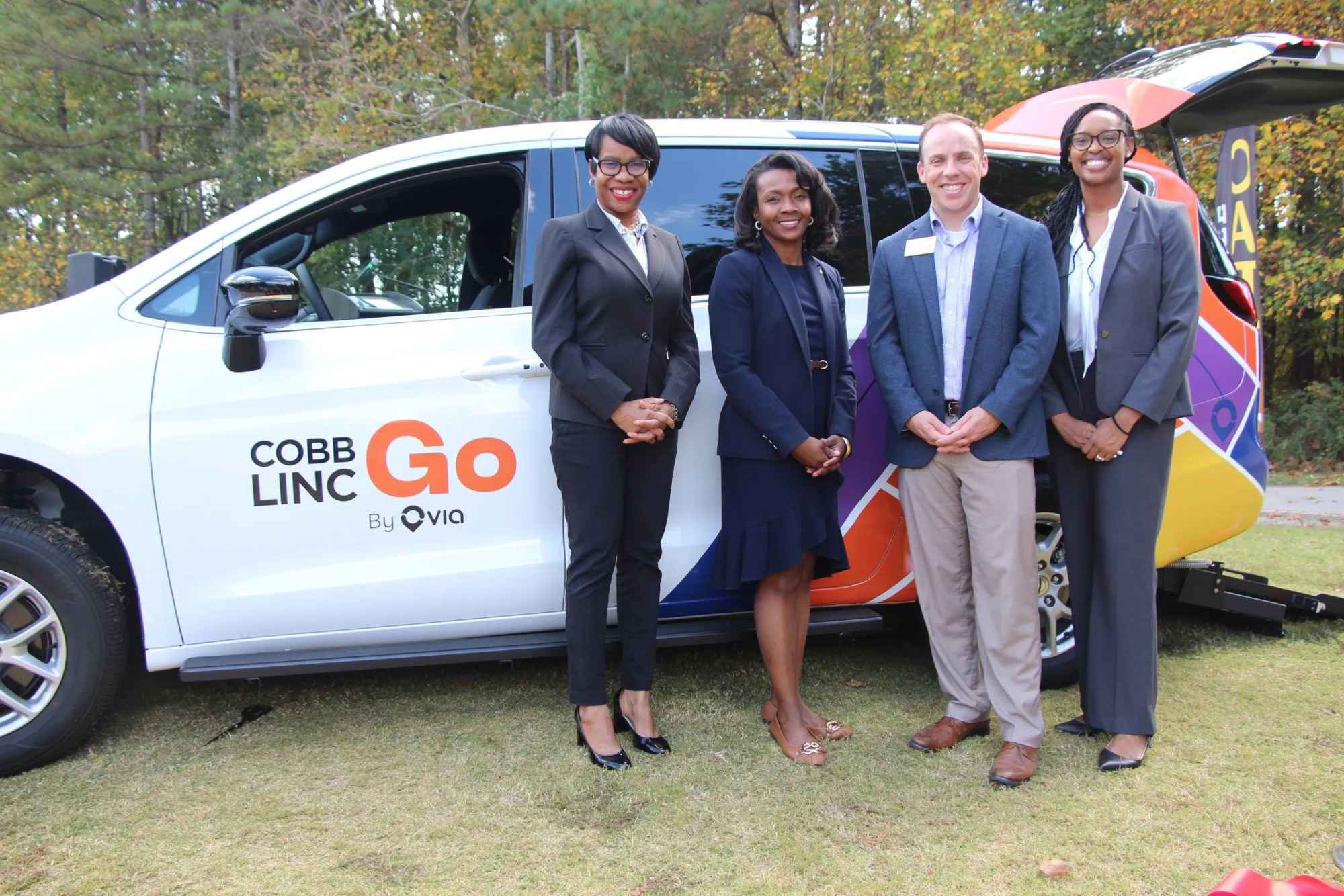
Despite the MSPLOST’s defeat, new Cobb initiatives like CobbLinc Go — an on-demand microtransit program launched just two weeks ago for South Cobb — show that smaller, incremental steps may clear the way for longer-term improvements.
With CobbLinc Go, residents in the designated coverage area — Austell, Powder Springs, and southwestern Marietta — can request a ride directly from their phones, bringing the transit stop to their doorstep. CobbLinc Go offers shuttle rides for $2.50 per trip, with services available Monday through Friday from 7 a.m. to 7 p.m.
Cobb Board of Commissioners Chair Lisa Cupid said the two-year pilot program will help Cobb learn where to add future microtransit options. The county will assess the pilot’s impact and viability, looking at data on service usage and frequency, along with vehicle efficiency in delivering rides to inform future transit decisions.

The intersection of housing and transportation
As Cobb’s population approaches 800,000, the county is also turning an eye toward housing solutions, such as changing residential zoning laws to allow ADUs. “Not everyone fits the single-family home model,” said Connor Manthey during the A Better Cobb webinar.
Lifting current single-family zoning restrictions would allow Cobb homeowners to add additional living units to existing single-family lots, providing affordable rental units or housing options for multi-generational families. That would give county residents more flexible and affordable housing options—whether for a college student, an aging parent, or renters needing smaller, budget-friendly housing, the A Better Cobb proponents said.
However, they added, introducing ADUs into local zoning laws has been met with resistance – noting that opponents have raised concerns about neighborhood character and property values.
Looking ahead
Local-option sales taxes – which require voter approval – remain a critical funding source for transit in Georgia, given the limited contributions from the state government, Stigall said. That leaves local governments few funding options beyond sales taxes, property taxes, and the occasional federal grant, although federal support is unlikely in the near term.
“The state doesn’t invest anything in transit—very little,” Stigall said. “Cobb County had to basically go for a grand slam because transit operations cost money, and we’re kind of on our own to raise that money.”
Cobb transit advocates are not giving up on asking voters to tax themselves for mass transportation. Looking ahead, the strategy is to focus on smaller, incremental projects like CobbLinc Go to increase public buy-in Advocates are also considering scaling back the tax ask to voters from 30 years to a shorter time period.
If Cobb can increase ridership and build momentum through smaller improvements now, there’s potential for broader support when voters reconsider transit funding in the future, Stigall said.
The major objection I heard from most people was it was limited to bus rapid transit. MARTA extension to Cumberland / Braves stadium and Kennesaw State areas were not even mentioned. Also not mentioned was the possibility of merging CCT with MARTA for connected area transportation. CCT by itself is too limited to justify these kinds of expenditures.