
Atlanta’s Office of Inspector General (OIG) has been in the news lately, facing criticism from Mayor Andre Dickens, accusations of “unprofessional” investigations from the city attorney, and possible new restrictions from a specially convened city council task force.
Amid the drama, it’s easy to forget that the city of Atlanta actually has two additional independent oversight offices — the Ethics Office and the City Auditor. Each has unique powers and limitations for ensuring transparency and accountability in city government.
So what are the differences — and what makes them independent? “We don’t report up to the mayor,” said Inspector General Shannon Manigault of all three.
The OIG is responsible for investigating fraud, waste, abuse, and misconduct within city government. While it has broad investigative authority — including the ability to initiate its own probes — it has no enforcement powers. Instead, it submits its findings, along with recommendations for further action, to the city.
The Ethics Office, by contrast, is tasked with enforcing Atlanta’s code of ethics for city employees, which can mean investigating gifts or conflicts of interest around procurement. Unlike the OIG, its investigations are limited to violations of the city ethics code, which it can initiate only if there has been a complaint. It does have enforcement power, but that’s limited to fines or termination for employees found to have committed ethics violations.
The City Auditor, meanwhile, ensures fiscal accountability by reviewing the city’s financial records and operational procedures. Unlike the other two offices, it can’t launch its own investigations and it generally lacks subpoena power, relying instead on scheduled audits to uncover inefficiencies or systemic issues.
Although each operates independently, the three offices work in tandem to promote integrity and transparency in Atlanta’s government. “We’re like a three-legged stool,” said City Auditor Amanda Noble, serving different but complementary functions.
Office of Inspector General: broad investigative powers
The OIG, created by the Atlanta City Council in 2020, is tasked with investigating serious allegations of misconduct in city government, including corruption, financial irregularities, and ethical violations. Manigault, who has led the office since its inception, said its independence from the mayor’s office is key to its work.
The OIG’s investigative powers are significant. It can launch investigations on its own, without waiting for a complaint, and it has the power to subpoena phone and financial records, and review internal communications within city government.
While it can request voluntary interviews from city employees and people who might have relevant information, the OIG rarely compels testimony: Doing so would make the testimony inadmissible in court, even though it could be used for administrative action.

Even though the OIG lacks enforcement authority, instead submitting its findings and recommendations to the city, it is able to work with law enforcement agencies, such as a county district attorney or the U.S. Department of Justice, on cases that may involve criminal activity.
“When I started here, I reached out to the commensurate offices to establish those relationships, because they’re important for any Office of Inspector General to have,” Manigault said.
The Inspector General is appointed by a citizen-led governing board, which also appoints the city’s Ethics Officer. Board members must be approved by the mayor and city council. Both the Inspector General and the Ethics Officer can only be removed for cause through a formal hearing process by the board.
Ethics Office: compliance training and prevention

Atlanta’s Ethics Office, established in 2002, takes a more preventative approach, focusing on education and training to ensure compliance with the city’s ethics code. Ethics Officer Jabu Sengova and her deputy, Carlos Santiago, emphasize that their primary role is to help city officials and employees avoid conflicts of interest and other ethical missteps.
The office oversees several disclosure systems, including requirements for city employees to report family relationships, outside business interests, as well as gifts received or travel expenses paid by outside entities while conducting city business. These systems are designed to promote transparency and prevent conflicts of interest before they occur.
Sengova explained that the Ethics Office only investigates complaints related to violations of the ethics code, such as improper gifts or undisclosed conflicts of interest. The office has access to city records and city employees have a “duty to cooperate” for interviews. It’s not a subpoena, but refusal to participate can have administrative consequences. Cases involving potential fraud or criminal activity are referred to the OIG.
To illustrate the division of responsibilities, Sengova offered an example: If a city employee had a business interest in a vendor for which they had procurement power, the Ethics Office would handle the conflict of interest. However, if there were an allegation that the vendor bribed the employee, the case would go to the OIG.
Santiago said ethics education is a cornerstone of the Ethics Office’s work. “We try to be proactive by educating the workforce, being available to respond to requests for advice, and when necessary, investigating any potential violations of the code,” he said.
City Auditor: fiscal accountability

The City Auditor, also established in 2002, focuses on financial accountability and operational efficiency. Unlike the OIG, it does not investigate individual misconduct but instead reviews the city’s systems and procedures to identify inefficiencies or areas of improvement.
“Audits can find red flags, but we’re looking at the systems of control. We’re not looking at individual bad behavior,” Noble explained.
An external accounting firm, currently Mauldin and Jenkins, handles the actual auditing of the city’s finances, while the auditor’s office focuses on program and policy reviews to ensure the city’s resources are used effectively. Noble said her office has broad access to city records but cannot subpoena financial or phone records.
Audits follow a schedule approved by the city’s audit committee, whose members are selected by city council, the council president, and the mayor. This committee also appoints City Auditor, who can only be removed for cause by a two-thirds vote of the 15-member city council.
Like the OIG, the City Auditor does not have enforcement authority. Simply put, Noble said, “We can say something looks funny.” The auditor’s office relies on the OIG or other city agencies to dig deeper when necessary.
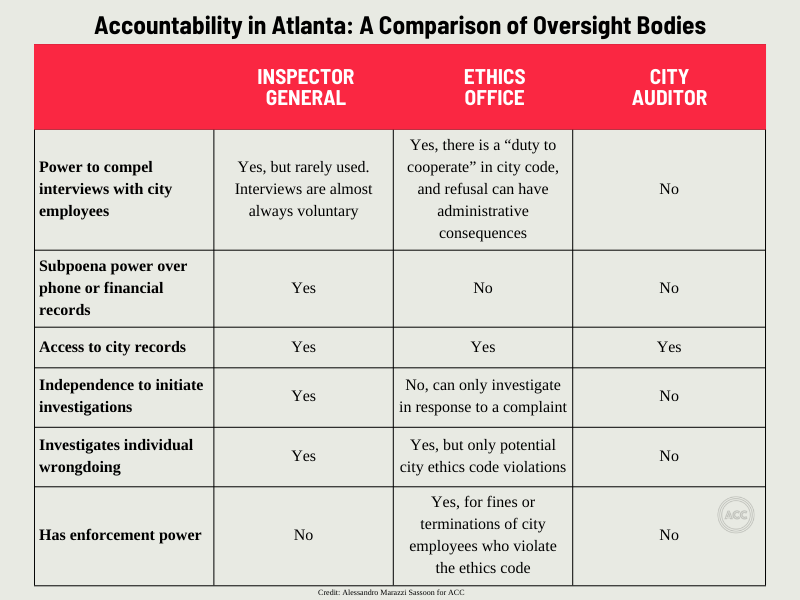
Note: This story has been updated to reflect that the Atlanta Ethics Office can’t subpoena city employees for interviews, but employees do have a duty to cooperate with interview requests -Ed.