

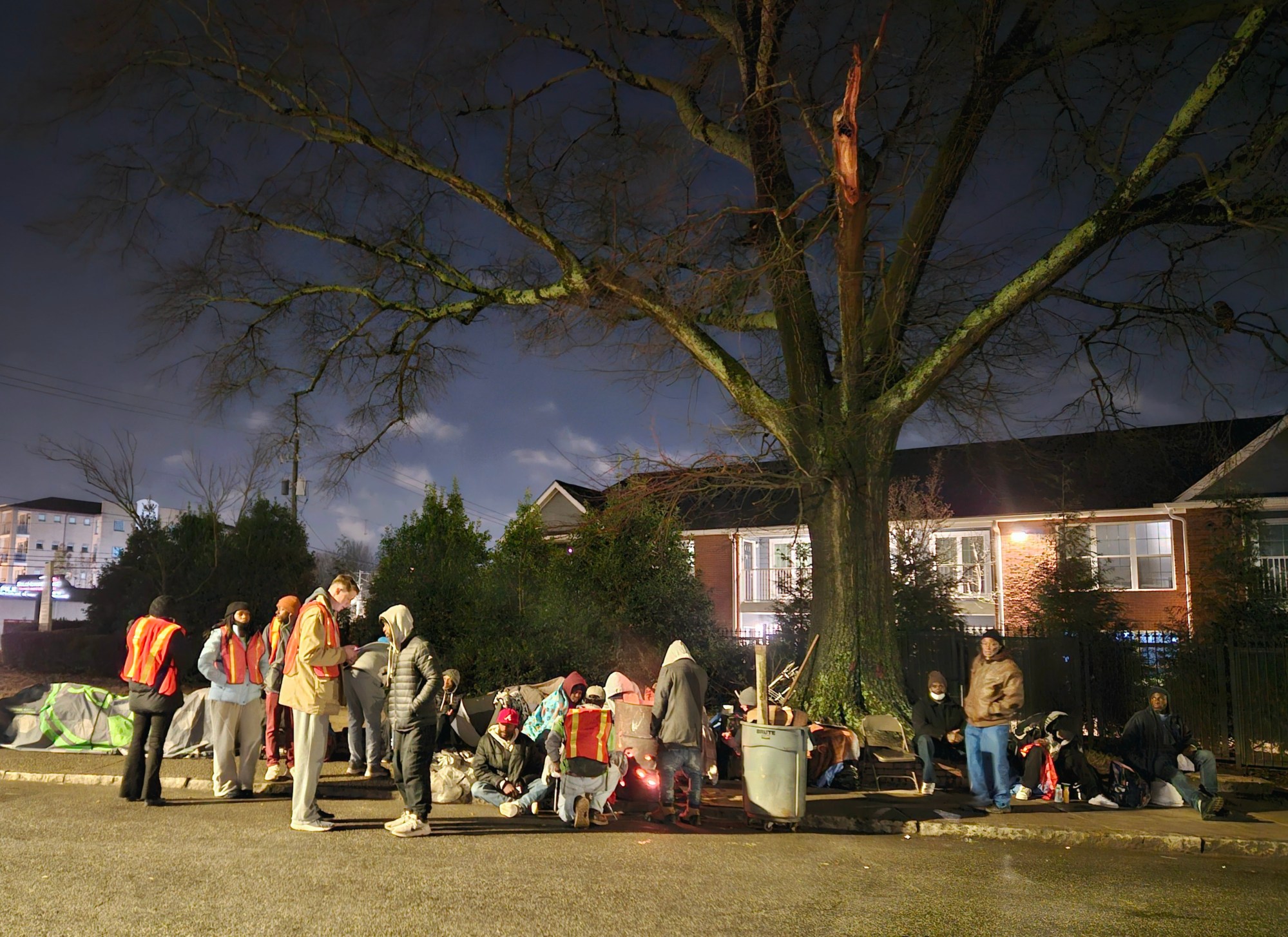

Every year, on a single night in January, the city of Atlanta’s go-to homeless services nonprofit, Partners For HOME, deploys a small army of volunteers to take a headcount of the city’s unhoused population.
On Monday, 212 people representing some 50 nonprofits and advocacy groups scattered across the city for the Point-in-Time (PIT) Count, which is federally mandated to give local governments an up-to-date picture of the scale and nature of the crises they face — and to give the U.S. Department of Housing and Urban Development a snapshot of the nation’s homelessness problem.
It’s an imperfect process, relying mostly on untrained volunteers to track down people living under bridges, in cars, in wooded areas, or behind buildings — and then ask them about their living situations, medical, mental health and substance use histories, and how they became unhoused.
The findings from the annual census of unhoused people are vitally important for local policymaking. Lawmakers use local PIT Count data to allocate funding for homeless services, as do nonprofits working to connect people to shelter and healthcare services, and foster housing for low- and no-income people.
“The data you’re going to collect tonight, and the context you’ll be able to establish with that data with the interviews that take place, give us the information we need to make decisions about how to allocate resources,” Jack Hardin, the Gateway Center homeless shelter’s board chair, told the volunteers gathered at St. Luke’s Episcopal Church in Midtown, before they fanned out across town.
Surveyors clad in bright green t-shirts and orange reflective vests asked unsheltered people about their age, race, gender, and sexual orientation, as well as questions about when and how they first experienced homelessness, whether they’ve served in the military, been incarcerated, or been diagnosed with medical or mental health issues.
In exchange, survey respondents received $10 Kroger gift cards and, if requested, a ride to the nearest homeless shelter.
The PIT Count crews set out shortly after 8 p.m. on Jan. 27. What began as an awkward process — like occasionally asking people if they were unhoused and learning they weren’t, or having to wake someone up to ask questions — soon gained welcome attention as word of their mission (and of the Kroger gift cards) spread.

Many people whom the PIT Count teams encountered were fully transparent. But some, either intentionally or inadvertently, offered confusing information about their past or present circumstances.
When Emma Beers, a policy analyst for housing advocacy nonprofit Homebase, asked a woman beneath an Interstate-20 bridge in West End whether she lived with mental health challenges, the woman, cloaked in a striped comforter and a plastic rain poncho, said no.
But the woman then explained that she’s long lived in Michigan and expects to spend the rest of her life there — or here?
“I said, ‘But we’re in Atlanta now,’” Beers said. “She responded, ‘I used to be in Atlanta, but that portal takes you to Michigan.’ I can’t go back and change her answers now.”
Tommy Elam, on the other hand, seemed forthright — albeit resentful — about his living arrangements, when a volunteer group found him huddled beside a barrel fire with a dozen or so others outside the Atlanta University Center.
Elam said he sleeps on a small patch of grass just outside Cleopas R. Johnson Park on Larkin Street, right off Northside Drive on the Westside. He said he’s been homeless for almost five years, since he was laid off from a job at The Coca-Cola Co. at the onset of the COVID-19 pandemic.
A native of Richmond, Virginia, Elam said he’s worked as a painter since then, doing interior and exterior work at both commercial and residential properties.
“It’s pretty tough out here,” he said. The painting gigs are few and far between, especially since another unhoused person stole his phone. Elam sleeps in a sleeping bag most nights — and when it rains or snows, he’s sometimes able to share a corner of a tarp owned by one of his neighbors. “It’s not fun out here.”
Elam recently learned about Mercy Care, a local nonprofit that assists people who struggle with housing insecurity and medical and mental health problems. He said he hopes the organization can connect him to housing soon and help him get stable employment.
The volunteers stay out on the streets until they’ve conducted as comprehensive a headcount as possible, scouring almost all of Atlanta’s 132 square miles. On Tuesday morning, they wrapped up just before 3 a.m. The survey results should be published in a few months.
