

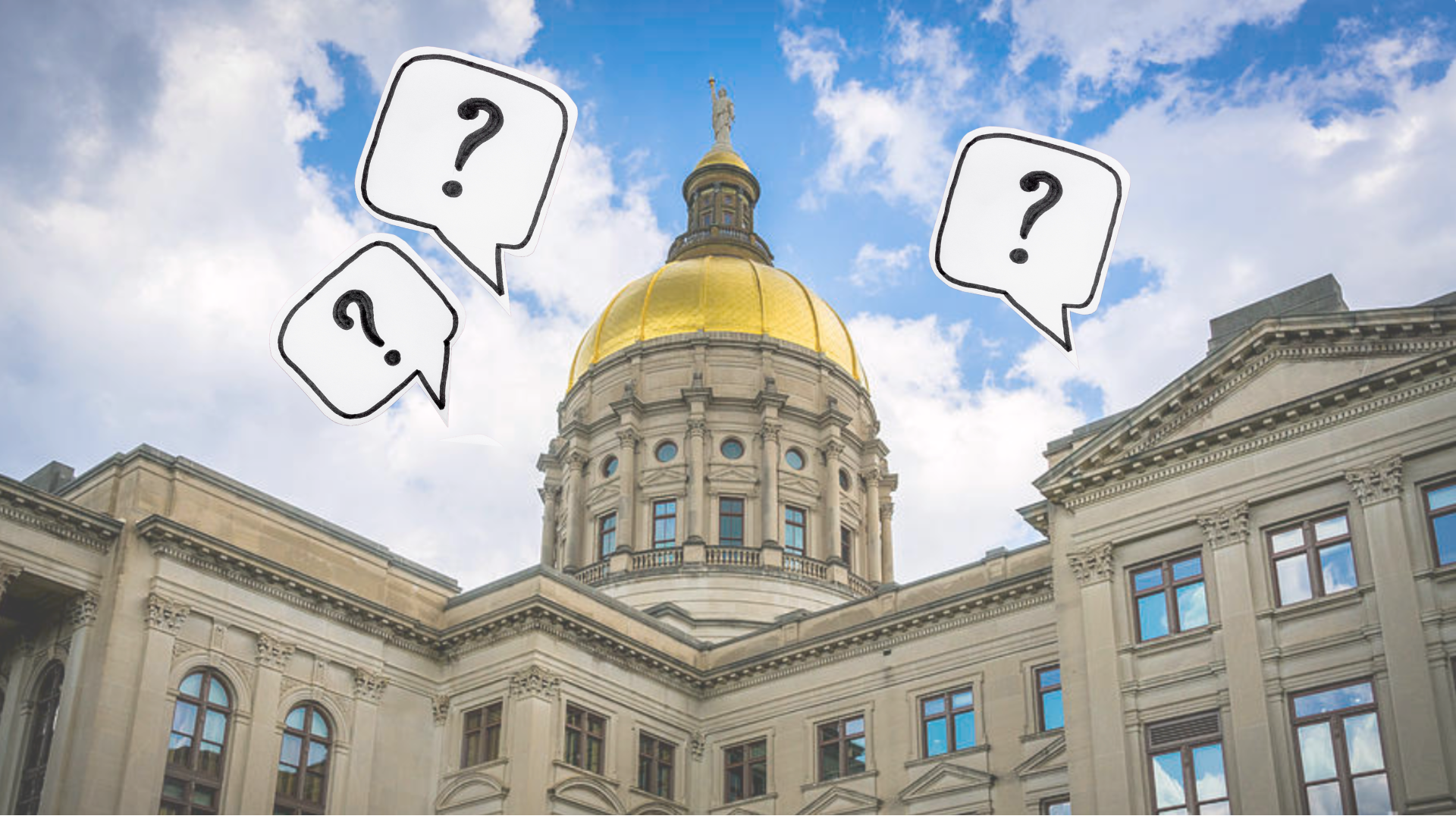
As the Georgia legislative session ramps up, Republicans continue to wield control. They hold a 100-to-80 member majority in the state House of Representatives, maintaining a firm grip on the chamber. In the Senate, Democrats were unable to flip any seats in the last election, leaving the GOP’s 33-to-23 member edge intact.
The challenge is clear for the Democrats: As the minority party, what can they actually get done?
Although they’re the minority party, that doesn’t mean the Democrats are powerless, said Kenyatta Mitchell, a longtime lobbyist at the Gold Dome for both government and business.
“Even though you’re a member of the minority party, you can still make baby steps happen. It’s all about introducing small ideas,” Mitchell said. “There are lots of instances where the minority party is able to influence legislation very strongly because of their numbers, especially in the House.”
Democratic lawmakers are entering the 2025-2026 session with new leaders in both the state House and Senate to coordinate their legislative strategy and communicate their positions. The House Democrats elected Columbus Rep. Carolyn Hugley as minority leader for the next two years, while Senate Democrats elected Augusta Sen. Harold Jones II as their minority leader.
Hughley succeeds former Rep. James Beverly, who didn’t seek reelection after his Macon district was redrawn, while Jones replaces former Sen. Gloria Butler of Stone Mountain, who retired.
Legislative power structure
As the majority party in both chambers, Republicans run committee hearings, where most bills either live or die – and it’s House Speaker Jon Burns (R-Newington) and Senate Majority Leader Steve Gooch (R-Dahlonega) who dictate which bills move forward.
On the Senate floor, Gooch, as the majority leader, also has what’s called a right of first recognition. That means that the Senate’s presiding officer, Lt. Gov. Burt Jones, who’s also a Republican, recognizes him first when multiple senators seek to address the body. That allows Gooch to introduce amendments and substitutes to bills, or make motions to reconsider, before any of the other state senators.
The governor’s floor leaders hold influential positions in this power structure, representing the interests of Republican Gov. Brian Kemp’s administration in both the House and Senate. Kemp has yet to announce his picks for the current legislative session, which kicked off Jan. 13 – but when he does, those legislators will shepherd his agenda through each chamber.
“Not that they don’t have any influence on the policy, but they are the governor’s foot soldiers in each chamber. Everyone knows that a piece of legislation originating from one of the floor leaders is backed by the governor, so it comes with that cachet,” said D.J. Myers, an Atlanta lobbyist who’s the director of state and local government at Ohio River South.
Meanwhile, Jones, the Senate president, holds influence over both committee assignments for lawmakers and the Republicans’ legislative priorities in his chamber. Since Jones is expected to run for governor next year, he will likely be particularly attuned to voter sentiment, Mitchell said.
“If his decision is to run for governor, he would want to keep an eye on where the population is and where people are thinking politically at that particular moment,” she said. “Inflation changes people’s moods. Current events change people’s moods. All of these things change the trajectory of what a person is running for office may want to focus on.”
How the minority party gets (some) things done
Despite their numerical disadvantage, Democratic lawmakers can still make an impact, Myers said. Most of the bills that pass each session are bipartisan, he pointed out, even if it’s the most contentious fights that dominate the headlines.
“The highest priority Democratic agenda items opposed by the majority [party] have slim chances. But a lot of people don’t realize that 90% of the legislation that goes to the General Assembly is passed in a bipartisan manner,” Myers said.
Rep. Bryce Berry (D-Atlanta), a Gen Z legislator in his first term, agreed. “The things that get the biggest noise and biggest traction are those partisan battles. But 99% of things that will go through the state legislature are done on a bipartisan basis,” he said.
Setting the state budget is a top priority for lawmakers in both parties, Berry added, since it’s the main constitutional duty of the state legislature. ”That’s usually passed on a strong, strong, bipartisan, overwhelming majority. So there’s a lot more that unites this chamber — surprisingly, more that brings us together than that separates us.”
To influence legislation, it’s critical for the Democrats to build coalitions with their Republican counterparts, Berry added. “I think we should work with whoever, whenever, and however for the benefit of the state of Georgia. We’re all duly recorded representatives, and we all have a responsibility to work together,” he said.
Berry pointed out that Republican lawmakers also need to court Democrats’ support for their bills, because they don’t have the requisite supermajority to pass everything they want. He brought up the school voucher fight from the previous 2023-2024 session. In 2023, a Republican-backed bill to use state tax credits to fund private school tuition failed on the House floor, due to Democratic opposition. The next year, Senate Bill 233 finally passed, with some modifications.
“It just goes to show there’s not an outright majority for everything they want to pass. Coalition-building is so, so important – and that’s what people in Georgia expect us to do. They expect us to work together on the issues they care about to move the state forward,” Berry said.
As the minority party, Democrats will generally try to frame their bills to appeal to a broad range of voters, including those in conservative districts. By making the bill relevant to both Republican and Democratic constituencies, it gains wider support and is more likely to pass, Myers explained.
A good example of this is SB 76, a Democrat-sponsored bill in the 2023-2024 session to cap insulin prices at $35 per 30-day supply for state employees’ health insurance. It took two years, but the bill ultimately passed both chambers in 2024 by overwhelming margins.
Lobbyists for Democratic initiatives can also help minority-party legislation gain traction by offering expertise to lawmakers navigating complex issues, such as health care and education, Myers said. Legislators aren’t experts in every topic, so lobbyists try to educate them both on the broader policy areas and on how specific bills will benefit their constituents and Georgians overall.
That education can be crucial to building bipartisan support, Myers added. “You want to make the bill applicable to that member’s constituents in a positive way,” he said. “If they can go back home and say, ‘I supported this bill because it does this for you,’ to their voters, that is a good way to garner support for it.”
Making an impact
Impact isn’t always measured in bills passed – especially this year, since it kicks off a new two-year legislative session. Since lawmakers can try again next year to get their bills passed, success this year for a Democrat-backed bill could be getting a hearing or a floor vote in one chamber to build bipartisan support, Berry said.
“Showing up in my district and hosting community events is how we stay connected with our constituents, knowing we can’t accomplish everything as minorities,” he added. “It’s a fight. But at least we’re starting something beneficial for our district — whether it’s a scholarship, a mentorship program, or advocating at a town hall.”
