As Atlanta journalist Mario Guevara faces possible deportation, public calls for his release and pointed criticism of DeKalb County officials have intensified since DeKalb authorities handed him over to Immigration and Customs Enforcement (ICE) on June 18.
Doraville police arrested Guevara, the proprietor of MG News, while he was documenting a June 14 anti-Trump protest. They charged him with three misdemeanors — unlawful assembly, improperly entering a roadway, and obstruction of law enforcement — despite his clear identification as a member of the press.
Guevara, an El Salvadorian national who has lived in the United States for over 20 years, was due to be released on a signature bond June 16. However, local police held him in the DeKalb County Jail on an ICE detainer until June 18, when ICE took him into custody. As of June 19, he also faces misdemeanor charges in Gwinnett County, related to reporting on ICE activity.
ICE is holding him at the Folkston ICE Processing Center in South Georgia, 240 miles from Atlanta, while his lawyers fight the DeKalb and Gwinnett charges and his possible deportation. Guevara is legally authorized to live and work in the United States, pending his application for a green card, according to his lawyer.
Guevara’s arrest and the aggressive law enforcement response to the June 14 protest on Chamblee Tucker Road has sparked local and national public outcry against both ICE and DeKalb officials. DeKalb police — working with three other municipal police they called in to assist — deployed tear gas unprovoked on peaceful demonstrators, then arrested Guevara and at least seven other people.
‘A lack of leadership’
DeKalb resident Mike Edwards, 68, attended the June 14 protest. During public comment at Tuesday’s DeKalb Board of Commissioners meeting he said that he and other demonstrators were peaceful, but still experienced tear-gassing. The police, he added, were “totally inappropriate,” which he attributed to a lack of leadership from any officer “with authority and some composure.”
“As a result of that lack of leadership, there was an unreasonable use of force,” Edwards said.
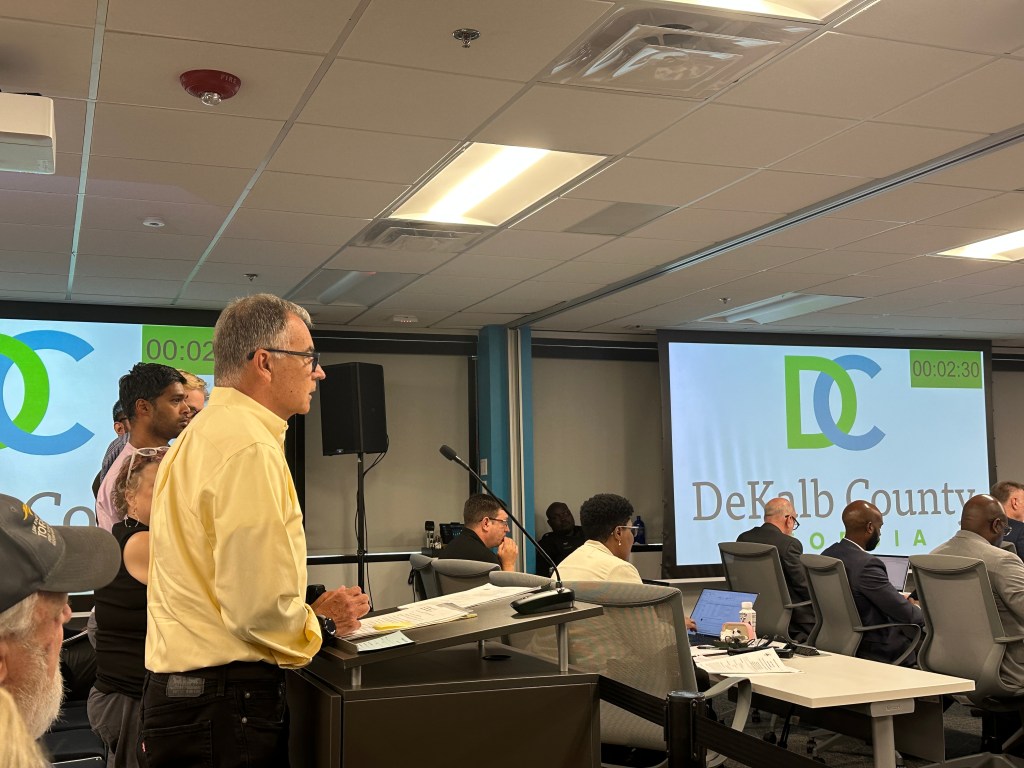
“Peaceful protest became state intimidation,” said another protest attendee, Jimmy Padilla, during public comment.
“Our constitutional rights were trampled — freedom of assembly, freedom of speech, freedom of the press,” Padilla said. “That wasn’t just a violation of our rights — It was censorship of local Spanish-language media.”
Padilla called out DeKalb CEO Lorraine Cochran-Johnson for breaking the public’s trust. “You first repeated the police narrative – unbelievable claims – dismissing hundreds of eye-witnesses. Now you call for a transparent review, but words alone won’t rebuild trust,” said Padilla, adding that he knew Guevara from volunteering with the Hispanic Organization Promoting Education (HOPE).
Padilla was one of several DeKalb residents at the June 24 Board of Commissioners meeting calling for Guevara’s release and criticizing DeKalb for arresting him.
That followed similar letters and statements from press freedom groups last Friday and then a demonstration in Lawrenceville on Saturday over Guevara’s ongoing detention.
“If Guevara’s case proceeds, it would represent a grim erosion of both freedom of the press and the rule of law. Journalists who are not US citizens could be at risk of deportation solely because local law enforcement filed misdemeanor charges against them in retaliation for reporting without those charges ever being tried in court,” said a June 20 letter from the Committee to Project Journalists and other press freedom organizations to Department of Homeland Security (DHS) Secretary Kristi Noem.
The Georgia First Amendment Foundation and the Atlanta Press Club were two of the signatories.
According to an emailed statement from DHS Assistant Secretary Tricia McLaughlin: “Guevara was arrested by DeKalb County, Georgia police for willful obstruction after he refused to comply with local police orders to move out of the middle of the street. He was turned over to ICE custody and has been placed in removal proceedings. This El Salvador national is in ICE custody because he entered the country illegally in 2004.”
DeKalb CEO’s response
The Committee to Protect Journalists had already called on DeKalb CEO Cochran-Johnson to release Guevara in an earlier June 17 letter. At that point, he was still incarcerated at the DeKalb County Jail.
The DeKalb CEO tried to distance herself from Guevara’s arrest in her June 20 response, when the DeKalb Jail had already released the journalist into ICE custody.
The DeKalb Police Department was not involved in his arrest, Cochran-Johnson’s letter said: “Mr. Guevara was arrested by the Doraville Police Department, an independent agency with its own command structure and prosecutorial oversight. So, DeKalb County Police Department [DKPD] had no role in initiating the charges against him.”
“DeKalb County does not participate in ICE enforcement actions and has no role in determining an individual’s immigration status or detainment,” Cochran-Johnson added in her letter. She also called for a “transparent review” of DeKalb’s response.
But Super District 6 Commissioner Ted Terry told Atlanta Civic Circle that because the protest took place in unincorporated DeKalb County it was under the DeKalb Police Department’s jurisdiction. “DKPD called together a multi-jurisdictional task force to respond to the three protests planned [June 14]. So [Doraville] city police were called in under the auspices of DKPD,” Terry said.
Terry said he determined that the DeKalb Police Department was in charge after he made a demand for information to the county — a right that commissioners have. While the Board of Commissioners approves funding for the county police department, it is Cochran-Johnson, as DeKalb CEO, who ultimately controls it.
DeKalb County did not respond to Atlanta Civic Circle’s emailed questions about the response to the June 14 protest from the Doraville and DeKalb Police Departments.
‘A violation of our constitutional rights’
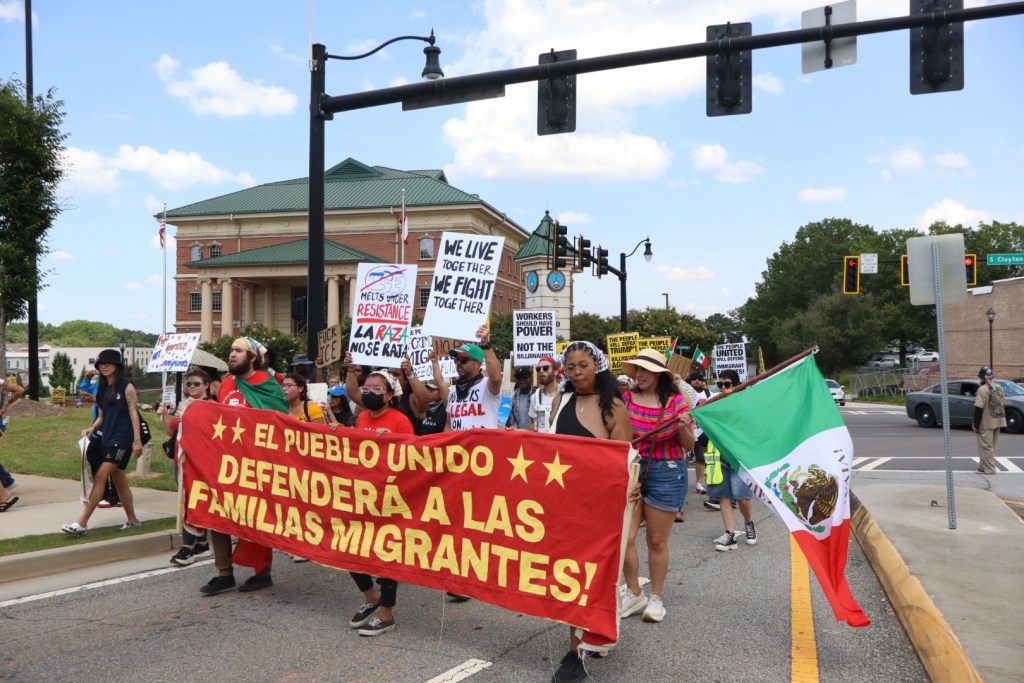
About two hundred people gathered last Saturday at a rally organized by the Party for Socialism and Liberation in Lawrenceville’s Bicentennial Plaza to protest against ICE and demand Guevara’s release.
Unlike the Doraville police at the rally a week earlier, Lawrenceville police were not wearing riot gear and made no arrests. Instead, they formed a perimeter so that the marchers could proceed safely in the roadway.
Cinqué Hicks, 54, said Guevara’s arrest motivated him to drive an hour to Lawrenceville for the rally from his home in Atlanta. “I have certain red lines, and one of my red lines is press freedom and artistic freedom,” he said. Hicks said he hopes local elected representatives will put pressure on ICE to release Guevara.

Jocelyn Villa was one of several people arrested at the June 14 Chamblee Tucker Road rally who turned out in Lawrenceville. She said police the previous week had arrested two women alongside her, who appeared Latina, and given them ICE information forms, even though they were US citizens. “It is racism we are facing. It is a violation of our constitutional rights,” Villa said.
At Tuesday’s DeKalb commission meeting, Nola Tillman, who was also arrested at the Chamblee Tucker Road rally, told Atlanta Civic Circle that she had witnessed officers at the DeKalb Jail tell two other women who’d been arrested to fill out ICE forms. They refused, Tillman said, after she and other women there advised them not to.
In an emailed response to questions, a DeKalb Sheriff’s Office spokesperson said: “As part of detention center booking protocol, arrestees are asked to declare their origin of birth [and] per HB1105, anyone declaring as a foreign national is asked to complete the immigration forms. Arrestees are not obligated to complete the forms.”
Disclosure: Atlanta Civic Circle is a member of the Atlanta Press Club, but did not participate in the Committee to Project Journalists’ June 20 letter to the DHS secretary.