

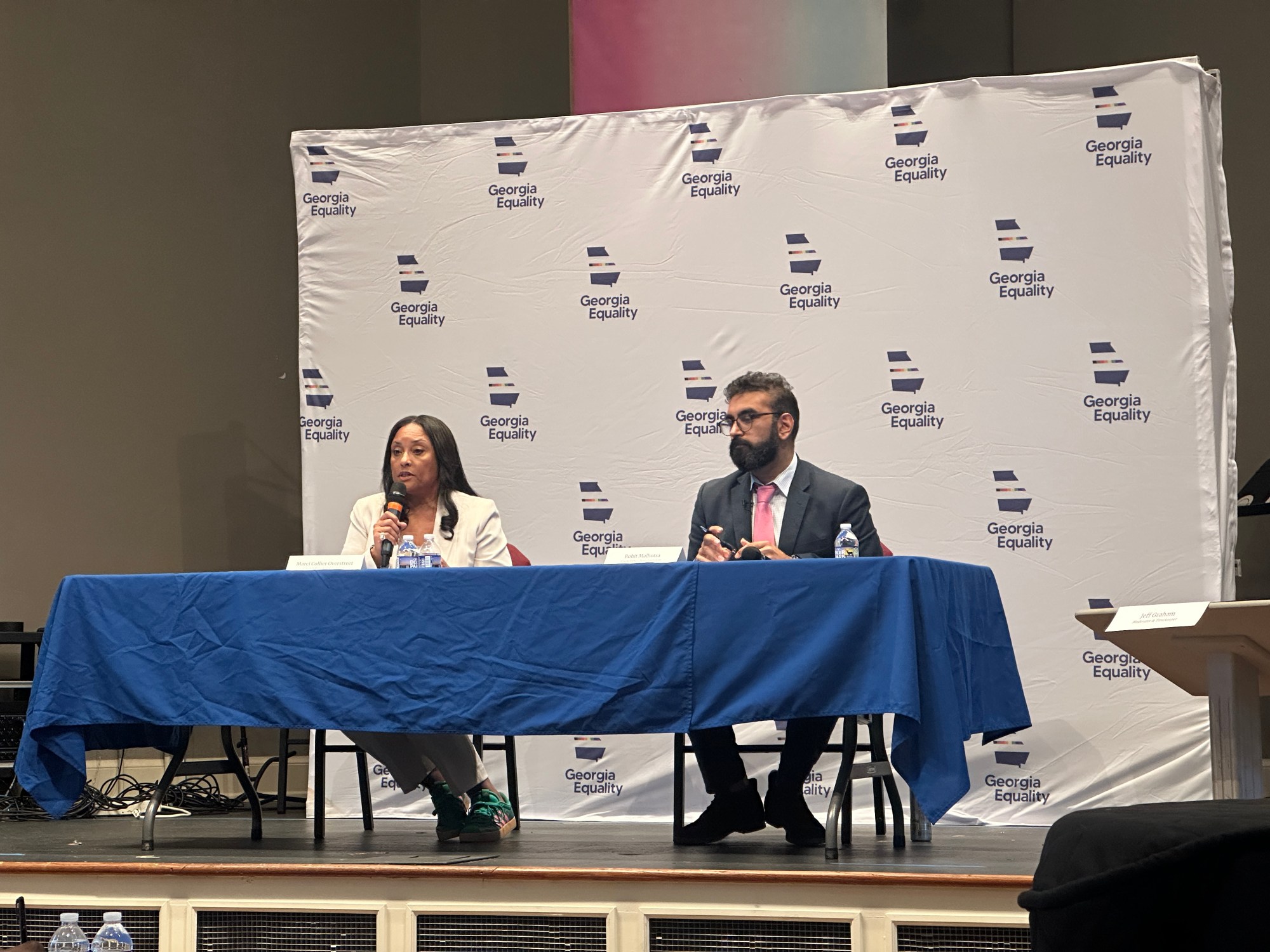
The two candidates for Atlanta City Council president, Rohit Malhotra and Marci Collier Overstreet, offered competing approaches to governing in the face of uncertainty over federal funding at a Tuesday forum hosted by LGBTQ rights groups Georgia Equality and the Human Rights Campaign Georgia.
Overstreet, who’s represented District 11 on the city council since 2018, pitched herself as a steady, experienced hand who knows how to use the tools of municipal government to solve problems. Malhotra, the co-founder of the Center for Civic Innovation, offered himself as a progressive alternative to reimagine how the city serves Atlantans.
Held at Neighborhood Church ATL in Candler Park, the forum was moderated by Georgia Equality’s deputy director Chanel Haley and Daniel Driffin, a public health consultant focused on communities impacted by HIV and AIDS.
A key question they raised was how the city of Atlanta should best steward its federal HOPWA (Housing Opportunities Program for People with AIDS) funds to provide supportive housing to people with HIV. Georgia has one of the highest rates of new HIV diagnoses annually, with almost 2,400 new infections reported in 2023, mostly concentrated in the metro Atlanta area. Supportive housing is key to helping people with HIV stay in treatment, so that they stay virally suppressed and can’t transmit the virus.
For FY 2025, the city received roughly $15 million in HOPWA funds from the US Department of Housing and Urban Development (HUD). It disburses the grant money to service providers that provide housing and case management to people living with HIV, both within the city of Atlanta and across the 29-county metro-Atlanta area.
But across multiple mayoral administrations going back nearly two decades, Atlanta-area housing providers didn’t receive the HOPWA grant money on time from the city, causing service interruptions, said Georgia Equality’s executive director, Jeff Graham. At one point, he said, the city had to return millions of dollars in unspent funds to the federal government.
“The problem was that nobody on the city council was holding the administration accountable,” Graham said. In response, the Atlanta City Council created a HOPWA Modernization task force three years ago. Recommendations adopted by the mayor’s office fixed the problem, said Graham, who served on the task force along with two AIDS nonprofit leaders, City Council President Doug Shipman, Councilmember Jason Dozier, and city staff.
Georgia Equality isn’t endorsing either candidate for city council president, but Graham emphasized that the city council and its president must continue active oversight over how the city manages its HOPWA funds.
“Ensuring we are not mismanaging funds is a legislative role,” Malhotra agreed. He pitched “bold leadership,” saying it’s up to the city council to make sure the mayor’s office is serving residents properly.
Overstreet, by comparison, said radical change is not needed to keep the city working – and that voters should instead look to her eight years of experience on the city council.
“It is absolutely necessary that we stay the course to continue the progress that we’ve made on HOPWA,” Overstreet said. While she didn’t serve on the HOPWA Modernization task force, she pointed to it as an example of the city council’s ability to solve problems.
Responses to funding threats
The Trump administration’s attacks on LGBTQ+ rights and attempts to end federal HIV/AIDS program funding mean that city leaders must be prepared to find alternative sources of funding, advocates like Graham warn.
The Trump administration sought to cut HOPWA’s $550 million appropriation entirely for FY 2026, but the funding ultimately survived in the congressional spending bill that Trump signed July 4.
Even though HOPWA was spared, changes to HUD’s appropriations formula left Atlanta with a $7 million funding shortfall for the past fiscal year – down from almost $23 million in FY 2024.
Given the rise in both housing costs and new HIV/AIDS diagnoses in the greater Atlanta area, Graham said, the city’s leaders must assess the unmet needs for people with HIV/AIDS and ensure nonprofit service-providers “have the financial resources to meet those needs.”
For instance, Status: Home, which relies on HOPWA funding to provide housing, hasn’t experienced any funding cuts. “However, there’s still a lot that’s unknown on the horizon,” CEO Maryum Phillips recently told Atlanta Civic Circle.
Malhotra said the Trump administration’s unprecedented actions makes the status quo insufficient for Atlanta governance. “We’re not going to be able to task force our way out of this,” he said.
Instead, Malhotra said, the city needs to find funding to ensure the needs are met for vulnerable Atlantans, such as those living with HIV.
City services in general should be more accessible to all, he added, so that people living with HIV would still be able to count on the city for help if HOPWA funding were to disappear. “The success is finding dedicated [funding] resources that are allocated across city programming, and not just for HOPWA,” he said.
Malhotra warned that the federal government is “going on the offense,” pointing to executive orders that target LGBTQ+ programs and to HUD’s civil rights office pausing all gender-identity related discrimination cases. “I will not be someone who is hoping that HUD will come to the table in good faith. I actually think we need to operate as if they will not,” he said.
Overstreet said it’s important for Atlanta leaders to ensure that “HUD is absolutely at the table” for funding that affects Atlantans. Groups that receive federal grant disbursements from the city must also be well trained to access the funds, she said.
The city council has done more than studies and task forces, she added, pointing to its allocation of city funds to increase access to PrEP (pre-exposure prophylaxis), an HIV-prevention medication. “We’re putting funding where our mouths are,”she said.
“My work really is a record. It’s not rhetoric. It’s not pies in the sky,” Overstreet said.
You can watch the full candidate forum, which also featured candidates for city council districts 2, 7 and 11, on Georgia Equality’s YouTube page.
Note: This story has been updated to clarify that Status: Home has not experienced any funding cuts.


These stories are good to read.
What is going on about the stories of Atlanta Mayor & Overstreet sticking together just for the southside and black community?
What did they do with all the money from Marta transportation contracts?
and it looks as if only the Black Atlanta Elite Community is going to benefit.
Got healed from herpes