

Atlanta food pantries are scrambling to fill widening gaps in the social safety net as the federal government shutdown stretches into its fifth week.
Food insecurity is rapidly spreading for Atlanta families since the federal government failed to make SNAP payments to roughly 42 million Americans on Nov. 1. The unexpected halt of SNAP benefits, which support about 260,000 people in metro Atlanta, threatens to overwhelm already-strained community food banks and pantries.
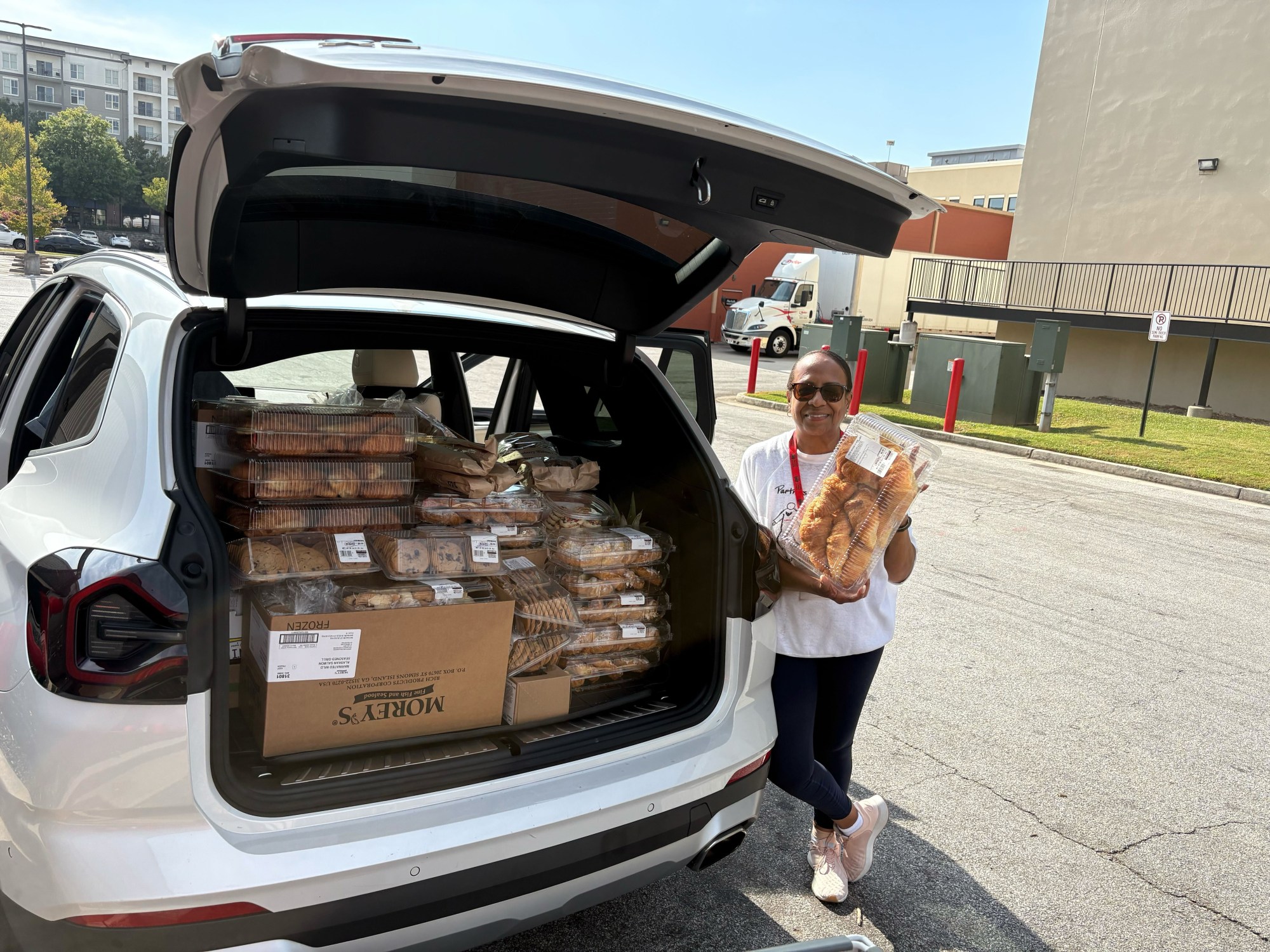
The need for food has more than doubled at POWER Atlanta, which provides a food pantry every Thursday at the group’s Southwest Atlanta headquarters near Capitol View. The pantry usually serves about 250 people per week – but last week 607 people came by, said executive director Adrienne Gates. The grassroots nonprofit also offers community services like housing and healthcare assistance.
Due to federal funding cuts, POWER Atlanta had already scaled back other programs, like on-site HIV testing, to keep the pantry running, Gates added. ”That has all but dried up through the funding cuts,” she said. “We can only issue the county [HIV] tests and free at-home kits right now.”
And that was before the SNAP freeze hit. As food costs rise, keeping the pantry going is the most urgent need right now, Gates said. “People are in panic mode already, so we’re just trying to see what we can do to combat that,” she said. “When I say ‘one day at a time,’ it’s almost like ‘one hour at a time.’”
Nonprofits can’t replace federal safety net
At Second Helpings Atlanta, demand for food rose gradually over the summer – and now it’s spiking even higher, because of the uncertainty around SNAP payments and additional food needs from furloughed federal workers, said executive director Paul Clements. The food-rescue nonprofit redistributes surplus food from grocery stores, restaurants, schools, and farms across Atlanta to food pantries and shelters.
“We knew a wave of need was coming, but that wave is hitting the shores a lot sooner,” Clements said. “Most [food-distribution] agencies are seeing a 30% increase in need already, and government employees are starting to show up at food pantries, once their savings run out.”
Clements emphasized that community assistance nonprofits are only able to supplement the federal safety net, not replace it entirely. “SNAP is the frontline defense for hunger in the US,” he said. “People who are living beneath the federal poverty level desperately depend on that.”
In Georgia, 1.36 million people rely on SNAP assistance each year, receiving on average $186 per month for food per person. To qualify, their net income must be at or below the federal poverty level, which is $15,650 for an individual.
”The nonprofit ecosystem that provides free food assistance is really not equipped to handle this level of demand that could potentially be hitting,” Clement warned.
Community support is key
“The sector feels extremely squeezed now … It’s leaving a lot of nonprofits burdened,” said Akilah Watkins, CEO of Independent Sector, a national consortium of charities. As federal funding continues to shrink, she said, Atlanta families could go without essential services, because nonprofits don’t have the resources to fill the gap.
The Independent Sector convened nearly 1,000 nonprofit leaders in Atlanta in late October for its annual National Summit, where they strategized ways to navigate financial uncertainty from federal cuts in a politically polarized landscape.
“Nonprofits are looking at any and all solutions as it relates to meeting this moment financially,” Watkins said. “We know we’re going to get through it, but we want to be as adaptive as possible, so we can meet the needs of the American people during this moment.”
“America has a very rich history with volunteerism,” Watkins added. “However, those numbers have dipped, and we’re seeing some of the lowest levels of volunteerism since we began tracking it.”
Watkins emphasized that philanthropy plays a crucial role in meeting community needs, but it has limits. “Even if we emptied all the endowments in the country, we’d have only two months of funding for the 1.9 million nonprofits that do the great work of this country,” she said.
She urged foundations to “step up as much as they can now” to meet growing local needs, while also advocating for long-term policy solutions.
POWER Atlanta and Second Helpings Atlanta both rely heavily on support from local businesses and volunteers to operate. For instance, at Second Helpings Atlanta volunteer drivers pick up and deliver surplus food, so there is no charge to either donors or recipient organizations.
Despite the challenges, the two nonprofits’ leaders expressed hope. Clements of Second Helpings Atlanta said the city’s strong culture of volunteerism and business engagement offers a path forward. “If there’s any community that could solve hunger in the United States and create a model that would be scalable to other communities, it would be Atlanta,” he said. “We’ve got a great community of people who step up to volunteer and help their neighbors.”
At POWER Atlanta, Gates said local nonprofits are leaning on each other, and sharing resources and strategies where possible. That collaboration is vital to sustaining services for Atlantans in need during the extended federal shutdown, she added.
Need food?
For Atlantans in need of food assistance, check the Atlanta Community Food Bank’s interactive map of food pantries near where you live. You can also text “FINDFOOD” or “COMIDA” to 888-976-2232 for a list of the closest food pantries and their phone numbers.
How to help
- Second Helpings Atlanta: Volunteer or donate food from your organization at secondhelpingsatlanta.org, or call 678-894-9761.
- POWER Atlanta: To donate or volunteer, go to poweratl.org.
