


As Atlanta prepared to host the 1996 Olympic Games, the city built a jail.
The Atlanta City Detention Center opened in 1995, pitched as a pressure valve for the upcoming influx of visitors; with hundreds of thousands of people expected for the Olympics, officials warned, the overcrowded Fulton County Jail on Rice Street would not be able to handle a surge in arrests.
For people like Allen Hall, who’ve endured chronic homelessness, it felt like something else entirely.
“The jails became homeless shelters,” said Hall. The 72-year-old remembers people packed “wall to wall” in cold, cramped cells as the city showcased itself to the world.
Hall was arrested in 1996 while living under an Old Fourth Ward bridge, then jailed after police discovered crack cocaine in his pocket. But he believes he would have been locked up regardless.
“No question about it, the Olympics was why people were being arrested,” Hall said. For local unhoused people back then, it was either jail or a one-way bus ticket out of town, courtesy of Fulton County, he added. An estimated 9,000 low-income Atlantans were arrested in the 18 months leading up to the 1996 Olympics, according to WBUR.
With the FIFA World Cup fast approaching in June, Hall fears déjà vu.
Hall finally moved into an apartment in January, with assistance from housing advocates and city leaders, after spending the better part of 30 years living on the streets of Atlanta, caught in the seemingly inescapable grip of drugs and alcohol.
The city’s approach to homelessness has evolved since the ‘90s, Hall said, so he worries less about police jailing unhoused people for quality-of-life misdemeanors, like loitering, public intoxication, or public urination — at least when major events aren’t on the horizon. Cathryn Vassell, the head of the city’s homeless services nonprofit, Partners for Home, “should be given the Nobel Peace Prize for her leadership in spearheading the end of homelessness,” he added.
But because there isn’t enough affordable housing or public funding to eliminate homelessness in Atlanta, he does worry that city leaders and the Atlanta Police Department will default to their old habits. Hall remembered Mayor Andre Dickens’ pledge last June to “make sure those unsheltered individuals don’t come anywhere downtown, and throughout the city of Atlanta.”
“If you break the law, we have measures to deal with that like any other lawbreaker,” Dickens said at the time.
Displacement isn’t the goal, city says
Vassell said the fear is misplaced, and that the city’s current focus on housing instead of jailing unhoused people is fundamentally different from what Hall experienced in the 1990s. Partners for Home and the city of Atlanta launched its “Atlanta Rising” campaign in 2025 with a goal to produce 500 rapid rehousing units by the end of that year, with support from The Coca-Cola Company, Southern Company, and other Atlanta corporations. It also includes street outreach and diversion services.
“Downtown Rising — the first phase of Atlanta Rising currently underway — isn’t about moving people; it is housing people,” Vassell said in an email. “More than 440 individuals who were living unsheltered downtown are now in stable housing with dedicated wraparound support to ensure long-term stability.”
Even so, Dickens’ comments in June struck a foreboding chord for Hall. He recently kicked his addictions, but still vividly remembers being incarcerated for them during the Olympics. Or, he wonders, was he just locked up for being poor?
Now that he’s housed, sober, and working with a homeless assistance nonprofit, Hall wants to make sure Atlanta doesn’t revert to using jails to clear unhoused people off the streets before the World Cup. But that’s a tall order.
Atlanta’s action plan: outreach and housing
During an operation last year to clear a homeless encampment in Sweet Auburn just days before the Martin Luther King Jr. Day festivities — and the College Football National Championship game — an Atlanta Public Works employee mistakenly ran over Cornelius Taylor with a bulldozer. Taylor, one of Hall’s close friends, had been asleep in a makeshift tent. He died in the hospital soon after — a tragedy that forced the city to confront its approach to homelessness.
In response, Atlanta convened a Homelessness Task Force in 2025 to recommend reforms to the city’s protocols for shutting down encampments. The new rules mandate giving encampment residents advance notice of sweeps, repeated outreach and tent-checks, and the option to relocate to a shelter, or, when possible, permanent housing.
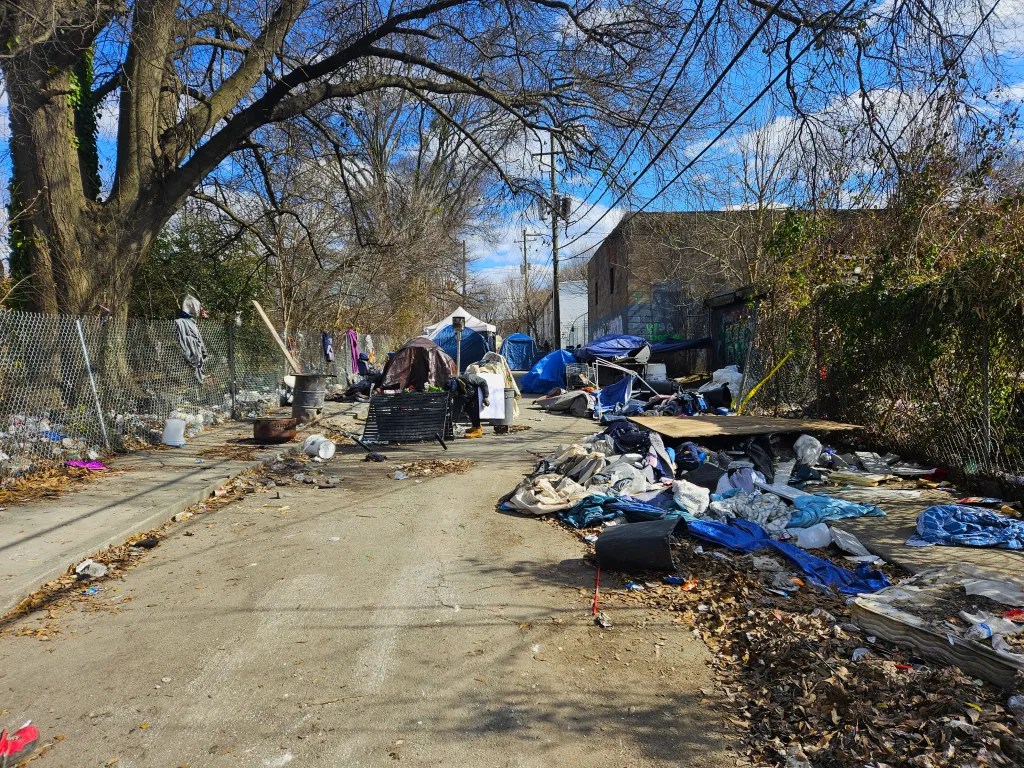
Last month, the mayor’s office unveiled the ATL26 Human Rights Action Plan, which builds on the task force’s recommendations by vowing to treat homelessness as a human rights and public health issue, not a law enforcement problem. In addition to Atlanta Rising’s rapid housing program, the city is deploying outreach workers to connect unhoused people to services and shelter and expanding public restroom access. Ahead of the World Cup, the focus is on downtown.
Vassell emphasized, however, that these efforts are not merely a short-term push tied to the World Cup. “Atlanta Rising is not about a single event — it’s a long-term effort to end unsheltered homelessness,” she said in the email. “This approach has already helped more than 15,000 Atlantans move into stable housing since 2015, with a 96% stability rate.”
Getting Atlanta to ‘play fair’
A new advocacy group, Play Fair ATL, wants the city to go further and guarantee that no unhoused people will be driven out of town, jailed, or otherwise forced off the streets to make the city look better for World Cup visitors.
Play Fair is demanding a ban on encampment sweeps and a moratorium on arrests or citations for quality-of-life offenses ahead of the World Cup. The group also wants the city to increase the number of rapid housing units it’s producing.
The goal was 500 by the end of 2025, but the city fell behind schedule. A Partners for Home spokesperson said it will hit that 500-unit goal by mid-April, with the debut of a Mechanicsville mixed-use development. But with nearly 3,000 people unhoused across the city — and about 1,000 of them unsheltered, according to the latest Point-In-Time headcount — even that won’t be enough.
“It seems like the city has two options,” said Play Fair executive director Michael Collins. “One is to house the people, but we don’t seem to have enough houses. The other option is put them in jail — and we’re obviously opposed to that.”
Tim Franzen, a community organizer with the American Friends Service Committee, agreed. “Either the city is going to have to just let people exist unhoused, or they’re going to have to round them up and put them somewhere,” he said.
But Vassell said the city will not resort to displacement or criminalization with the onset of the World Cup. “People are not being pushed out of downtown or into other neighborhoods,” she said. “Success is measured in housing stability, not displacement.”
The city’s focus is outreach, more than law enforcement, Vassell added. “This is not a criminalization strategy. We’ve worked with law enforcement to prioritize humane, trauma-informed engagement focused on outreach and housing — and arrests have gone down as a result.”
Hall hopes the city chooses a different path from 30 years ago. He’s no longer sleeping under bridges. He’s sober, housed, and helping others find their way off the streets. But he hasn’t forgotten what it felt like to be swept up in a system that treated poverty like a crime.
“I’ve seen this before,” Hall said.