

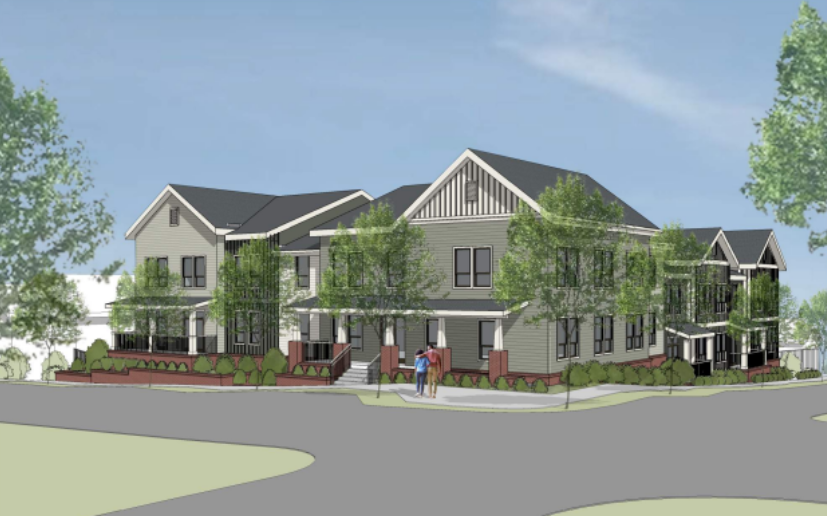
A controversial plan to build a 42-unit micro-apartment complex for homeless seniors in Kirkwood is headed for a final vote by the Atlanta City Council, after a public-notice error forced a redo vote by the city’s Zoning Review Board.
The city council’s Zoning Committee on Monday unanimously approved Stryant Investments’ request to upzone a lot at 88 Howard St. SE from single-family to planned development housing for an apartment building geared toward low- or no-income seniors. That tees up the rezoning request for a full council vote on May 18.
The Atlanta Zoning Review Board already approved the rezoning in February, but an administrative hiccup triggered a redo vote. Stryant co-founder Stan Sugarman said the city’s planning department mistakenly sent notices for the initial Zoning Review Board vote to residents living near 88 Howard St. NW — a Westside address — rather than to the 88 Howard St. SE project’s Kirkwood neighbors.
“It didn’t feel good to go back to the ZRB,” Sugarman told Atlanta Civic Circle. “It was a snafu.”
The Zoning Review Board again approved the upzoning on April 30. With the city council committee’s subsequent approval on May 11, the project is back on track for a mid-2027 groundbreaking if the full council signs off.
Stryant and Turner Monumental AME Church, which owns the adjacent 0.66-acre lot where the development is planned, have spent years working on the project, which would include publicly funded supportive services, such as substance use and mental health treatment.
The apartment building would house people ages 62 and older who have experienced homelessness and earn no more than $40,000 per year, which is roughly half of the area median income. That is the income cap to receive a Housing Choice Voucher for a rent subsidy from a local housing authority. To keep rents low, each of the 42 units would measure only about 250 to 275 square feet.
The project has drawn fierce opposition from a vocal contingent of neighbors who fear it would be too dense for the predominantly single-family community. Both the Kirkwood Neighbors Organization and Neighborhood Planning Unit O (NPU-O) — which represents Kirkwood, Edgewood, and East Lake — previously voted against the upzoning request.
At a January NPU-O meeting, virtually attended by more than 200 people, opponents raised concerns about traffic, public safety, the size of the apartments, and the limited parking.
Supporters have framed the backlash as a sign of Atlanta’s broader struggle to build housing for people exiting homelessness — especially in single-family neighborhoods where restrictive zoning and local resistance can make supportive housing projects for low-income Atlantans difficult to advance.
Financing is another challenge for the project, projected to cost upwards of $5 million. “We’re going to need subsidies,” Sugarman said, to get it built. “A lion’s share of our funding has to come from either the Georgia Department of Community Affairs or DeKalb County or the city.”

I wouldn’t have an opinion specifically for Kirkwood because I don’t live there. But when the Salvation Army applied for permits to build a family shelter in a sketchy part of my neighborhood, I worried that the location was not appropriate for my most vulnerable neighbors. Salvation Army knew it was iffy and their plans showed a play area on the roof…perhaps it was bullet casings on the street that caused them to see that kids walking to nearby Centennial Olympic Park would be ill-advised..
I wanted the Salvation Army to do a property swap with the low-rise apartment complex next door to the high-rise I live in. I spoke with them, I wrote to them, I spoke publicly. Let the apartment entity develop the existing SA property into residences and let the SA put families next door to me in supportive housing. I thought that was a good idea. I thought it was a perfect solution .
They didn’t.
Maybe the people in Kirkwood could appreciate that they live somewhere safe, convenient and desirable that could mean the world to vulnerable individuals and families.
Just my thoughts.