The arraignment of three campus protestors, ordinarily a mundane procedural matter, in DeKalb County Magistrate Court on Wednesday placed a sharp focus on the political tensions Israel’s war in Gaza has injected into American politics, even locally.
It was the first arraignment for any of the 28 pro-Palestine protestors arrested on April 25, 2024 on Emory University’s campus, when students, faculty, and community members were violently dispersed by Emory police, plus officers from the Atlanta Police Department and Georgia State Patrol. Of those arrested, 21 have since had their charges dropped or were offered diversion programs.
All three who appeared in court July 23 pled not guilty to misdemeanor charges ranging from criminal trespass to obstruction of justice.
But when Judge Mike Jacobs read out the two criminal trespass charges for one protestor, Alex Carson, his attorney Musa Ghanayem seized on language in the charging document that accused Carson of illegally “occupying” the Emory campus.
“You honor, did I hear that right? That ‘occupation’ was one of the words in there? I guess occupation is only legal when the powers that be allow it,” Ghanayem said, referring to the Israeli military’s ongoing occupation of Gaza.
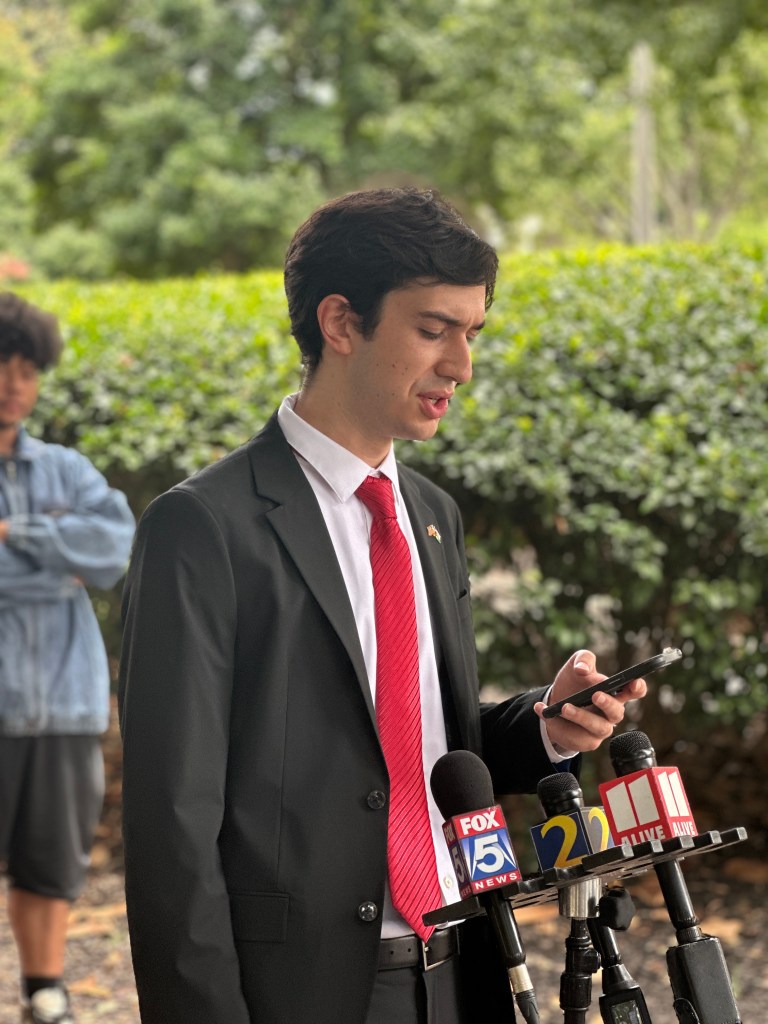
Jacobs asked Ghanayem, a Christian Palestinian-American, if he wanted to hear the charges again.
“I just saw the word ‘occupy’ in there — and then I see the reason that these children have been arrested, and I see that occupation is illegal in this country,” he said to finger snaps of approval from supporters in the courtroom’s public gallery, before Jacobs cut him off.
“I understand the nature of these parties, and I do want to just caution everyone that the judiciary is not a political branch of government,” the judge said to jeers from the gallery, prompting bailiffs to call for order. “My job here is to process these cases efficiently,” Jacobs continued. “We need to maintain order in the court and the dignity of judicial proceedings.”
Ghanayem thanked Jacobs for affirming the apolitical nature of the judiciary, but then noted that the reputation of DeKalb’s judges had been tarnished by DeKalb Superior Court Judge Stacey Hydrick, who resigned from the state’s Judicial Qualifications Committee for derogatory remarks on Facebook about Gaza.
“There’s a disgraced judge on the sixth or seventh floor here that has been removed from the Judicial Qualifications Committee for openly making political statements online about the extermination of the Palestinian people,” he said. “So that has put a blemish on the DeKalb judiciary.”
Sebastian Cadiz Garcia and Erica Kadel Schneider also pled not guilty. Both face two criminal trespass charges apiece, and Schneider has also been charged with obstruction of law enforcement. Like Carson, neither were Emory students or faculty at the time of the campus protest.
Before the arraignment, Schneider told reporters that she believes the DeKalb Solicitor’s Office pursued cases against the three to advance a narrative that they are “outside agitators.”
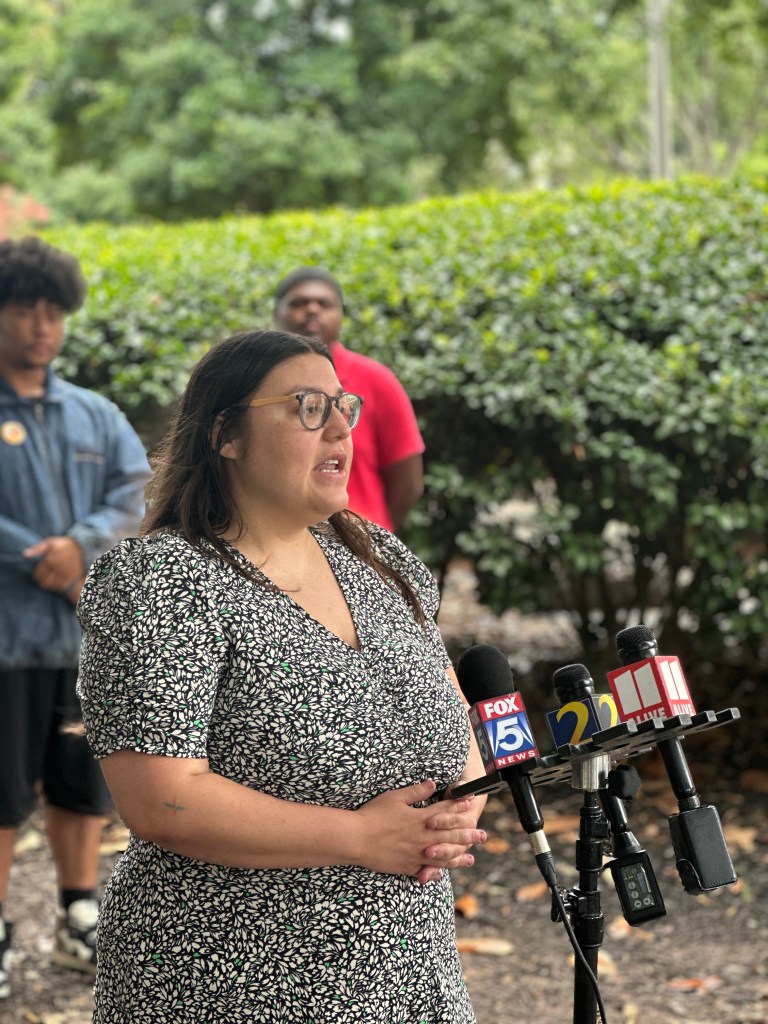
Schneider said that she and other organizers with the Atlanta Alliance Against Racism and Political Repression were heeding a call from Emory students when they came to protest at the campus encampment that day.
Carson, an organizer with the International Brotherhood of Teamsters at his workplace, UPS, said Emory and the law enforcement agencies that dispersed the pro-Palestine encampment last year are guilty of “an egregious violation of freedom of speech and assembly.”
Ghanayem, his attorney, said, “We must reinstill constitutional values in a place that has lost them.”
All three activists are due back in court Sept. 25 for a calendar call to schedule their trials. The DeKalb Solicitor-General’s Office did not immediately return an emailed request for comment.
Editor’s note: Atlanta Civic Circle is covering the arraignments of arrested campus protestors, because questions of how free speech is policed are of vital public interest.