

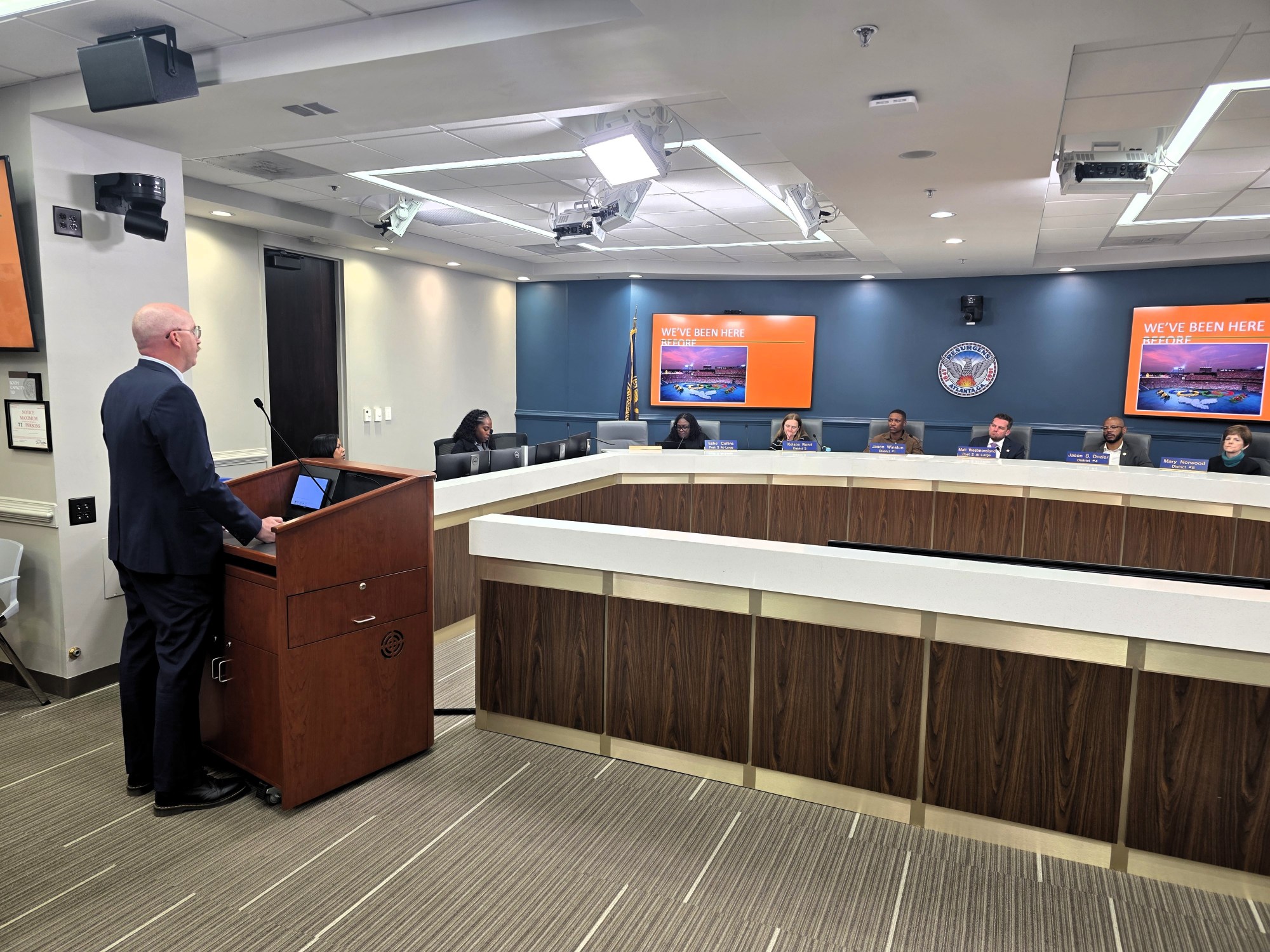

Several Atlanta City Council members raised fears Tuesday that the 2026 FIFA World Cup could mean a law enforcement crackdown on homelessness, with police displacing or even arresting unsheltered near downtown Atlanta matches.
“There’s a concern that we are at risk of criminalizing homelessness in a way that is contrary to the values that we have as a city,” said District 4 Councilmember Jason Dozier during an April 21 work session on Atlanta’s World Cup preparations by the council’s Community Development and Human Services Committee.
A new state law awaiting Gov. Brian Kemp’s signature will complicate Atlanta’s ability to compassionately address homelessness before, during, and after the World Cup, Dozier said.
House Bill 295 pressures local governments to enforce quality-of-life laws targeting unhoused people by allowing property owners to sue for damages if they don’t. That includes offenses like public camping, loitering, panhandling, shoplifting, and public drug use.
“Our state leadership has not been as values-driven as we have been as a city,” Dozier said. “That [bill] puts legal risk on municipalities if they don’t clean up or criminalize homelessness in these sorts of ways.”
New encampment-clearance protocols
Atlanta reformed its homeless encampment clearing procedures last year, after a tent-city sweep left 47-year-old Cornelius Taylor dead, crushed by a Department of Public Works bulldozer. The city’s new protocols mandate advance warnings and greater outreach about housing options to an encampment’s residents before dismantling it. However, they’re not legally binding, because they were not formally adopted through a council ordinance.
A new advocacy group, Play Fair ATL, has demanded an outright ban on encampment sweeps and a moratorium on arrests or citations for quality-of-life offenses ahead of the World Cup.
“My fear is that people are going to end up being arrested,” the group’s leader, Michael Collins, told council members. “That’s certainly what unhoused people are being told.”
Law enforcement interference could frustrate efforts to house homeless Atlantans, said Camille Russell from Partners for Home, the city’s go-to homeless services nonprofit.
“We don’t want to see our neighbors criminalized for homelessness — for being able to just survive out there,” she said. The best way to prevent that, Russell added, is to have outreach workers “being the first responders,” beating police to encampments to offer housing and supportive services before incarceration becomes an option.
The city last week concluded a two-year “rapid housing” effort, delivering 500 apartments for chronically unhoused Atlantans all over the city. But Atlanta has at least 1,000 unsheltered homeless people — and nearly 2,000 additional unhoused people living in shelters, due to the city’s persistent affordable housing shortage, so housing all who need it isn’t feasible.
What’s more, local law enforcement may be shutting down some encampments without following the city’s new protocols, District 2 Councilmember Kelsea Bond said.
“There’s been a growing encampment in the Freedom Park area,” Bond said. “They were told by a combination of [Atlanta] cops and park rangers to move out of the park, and it just ended up reshuffling everyone into a nearby alley closer to a residential area.”
Bond asked whether the Atlanta Police Department (APD) or other law enforcement agencies were required to abide by the encampment sweep rules that the city council, mayor’s office, and Partners for Home have pledged to follow. APD, Georgia State University police, and the Fulton County Sheriff’s Office did not respond to a request for comment.
Bond, along with Dozier and Post 3 At-Large Councilmember Eshe Collins, said they wanted clarity from the Mayor’s Office on whether APD, at least, will adhere to the new encampment closure policies.
“I’m a little confused, because I’ve been told conflicting information a couple of times,” Bond said. “I’ve been told that there is a very stringent process for engaging encampment sweeps — where there’s supposed to be several weeks of notifications and engagement with the folks in the encampment. And now I’m being told that the police have the ability to go ahead and escalate an encampment [closure] without communicating with you all.”
Mayor Andre Dickens’ office rejected the notion that APD has failed to comply with the city’s new protocols. “All parties involved are still required to follow the encampment closure protocols,” a Dickens spokesperson said in a statement to Atlanta Civic Circle after the meeting.
“This is institutionalized and will not change during the FIFA World Cup,” the statement said. APD’s Homeless Outreach Prevention and Engagement (HOPE) team “will not be reassigned during the FIFA World Cup events and will remain the trauma-informed care support required for encampment closures,” it added.
“Any information or statements otherwise are categorically false, and it is unfortunate that such disinformation is being perpetuated,” the Mayor’s Office statement said.
But shutting down encampments leaves unsheltered Atlantans with nowhere to go, said Play Fair ATL’s Collins. With the city and county jails already overcrowded and Atlanta’s housing supply strained, he said, the city has a choice: Let unhoused people exist where they are, or punish them for being in the way.
“The bottom line is, the eyes of the world are on us,” he said. “So if we get this wrong, there is a lot of potential damage to the reputation of the city.”