


Beyond TADs: Other public funding sources for Dickens’ $5.5B revitalization plan
Mayor Andre Dickens is relying heavily on tax allocation districts (TADs) to bankroll his $5.5 billion plan to invest in long-neglected Atlanta neighborhoods. Legislation introduced last week drops the Beltline and Perry-Bolton TADs, but would extend the lifetimes of the city’s other six active TADs through 2056.
The mayor’s office says those six TADs could generate between $5 billion and $7 billion over the next 30 years, assuming 5% annual growth in property values. But city officials and public finance experts alike told Atlanta Civic Circle that Atlanta will need public funding sources beyond tax increment revenue to make the Neighborhood Reinvestment Initiative a reality.
We delved into other public revenue options, from special service districts and other types of property taxes to upzoning charges on developers.
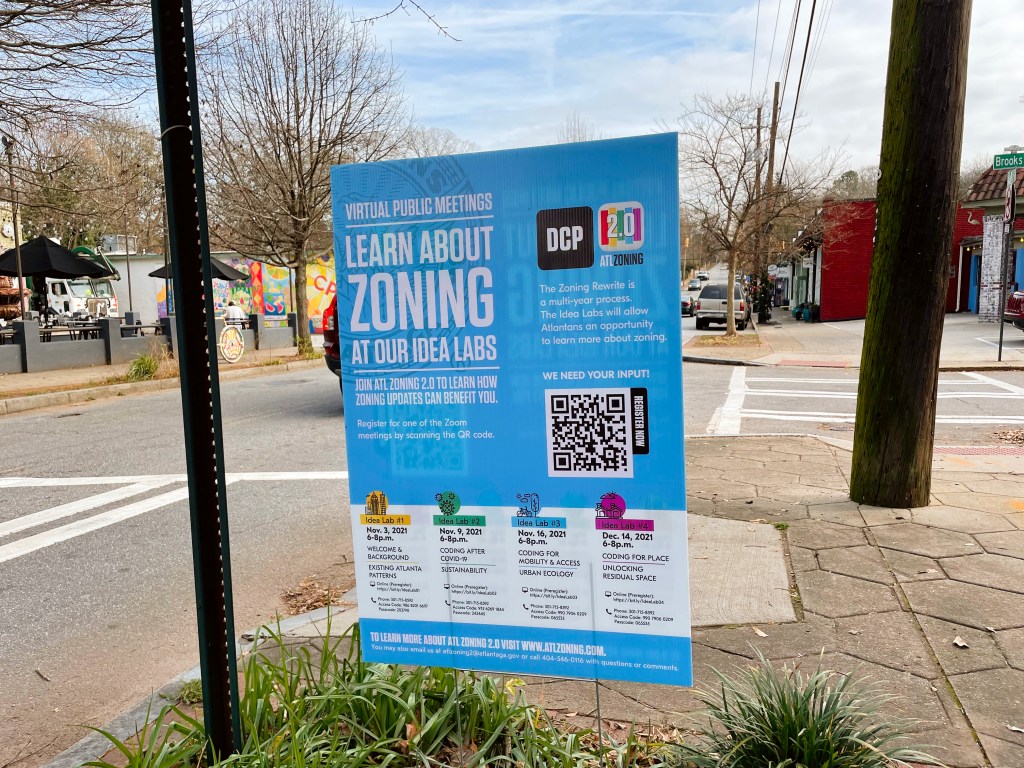
Will Atlanta’s zoning overhaul produce more of the same?
As the Atlanta City Planning Department approaches the finish line on ATL Zoning 2.0 — the long-awaited rewrite of the city’s antiquated zoning code — some local housing advocates fear it will retain much of the same low-density residential framework dictated by the current 44-year-old code.
Currently, over 60% of the city’s residential land is zoned exclusively for single-family residential use, instead of denser “missing middle” infill, like duplexes, triplexes, townhomes, and small apartment buildings. Housing advocates say Atlanta urgently needs these denser housing types, since building more housing on less land is a key way to make it more affordable.
Right now, the Atlanta City Planning Department is working on its third draft of the new zoning code, which could be the final draft it presents to Atlanta City Council for adoption. But some urban planning wonks worry Version 3 will look just like the first and second drafts, which they say didn’t appreciably reduce the amount of land zoned single-family residential in favor of denser housing.
Check out ACC’s report on urbanists’ critiques of the latest draft of ATL Zoning 2.0.
📷: Photo credit:Britton Edwards
Controversial Kirkwood senior housing complex advances
The Atlanta City Council last week approved a controversial plan to build a 42-unit micro-apartment complex for homeless seniors in Kirkwood. The apartment building will house people ages 62 and older, who have experienced homelessness and earn no more than $40,000 per year, which is roughly half of the area median income. To keep rents low, each unit will measure only about 250 to 275 square feet.
Stryant Investments’ request to upzone a lot at 88 Howard St. SE from single-family to planned development housing for the apartment building had drawn fierce opposition from a vocal contingent of neighbors who feared it would be too dense for the predominantly single-family community.
GEORGIA DECIDES
Housing is still on the ballot
Last week’s primary elections sent all but three statewide races to June 16 runoffs, meaning voters concerned about housing affordability will have yet another chance to cast ballots before the Nov. 3 general election.
Atlanta Civic Circle has published a pair of explainer articles breaking down how each state office — from governor to attorney general to lesser-know posts — influence how housing is funded, regulated, and built:
→ How four statewide elected offices affect your housing and living costs
→ How Georgia’s governor and other top elected officials affect housing
AH creating $60K down payment assistance program for Section 8 renters
Atlanta Housing (AH) chief executive Terri Lee this month announced the housing authority will offer as much as $60,000 in down payment assistance to help AH rent-voucher recipients buy a house.
The initiative, which could launch as soon as June, is solely for Atlantans receiving rental assistance from AH’s Housing Choice Voucher Program, Lee said at the housing authority’s annual “State of Atlanta Housing” event on May 12.
AH’s existing down payment assistance program offers up to $20,000 to lower income Atlantans who are first-time homebuyers – and up to $25,000 to current AH voucher holders, veterans, active military, first-responders, healthcare workers, and educators.
Read more about the budding initiative here.
A “sprint” to build housing in southwest Atlanta
An army of volunteers descended on southwest Atlanta’s Sylvan Hills neighborhood in early May to build an affordable housing subdivision. Some 2,500 mostly amateur construction workers built 24 homes over just five days. The new Langston Park development will have 60 homes for sale, from single family houses to townhomes, and all will be priced affordably for low- to moderate-income Atlantans.
The “home-building sprint,” The New York Times reported, doubled as a 40th anniversary celebration of Habitat for Humanity’s Jimmy and Rosalynn Carter Work Project.
Today’s newsletter was written by Sean Keenan and edited by Meredith Hobbs. Know someone navigating Atlanta’s housing market? Forward this to them—or share it with an organizer, landlord, or advocate who needs to stay informed on what’s happening in our region.
