


Remembering Cornelius Taylor

A city of Atlanta encampment-clearing operation on Jan. 16 left an unhoused man, Cornelius Taylor, dead at 47 years old. Witnesses said he was struck by a bulldozer while sleeping in his tent on Old Wheat Street, in Old Fourth Ward’s historic Sweet Auburn district. City officials confirmed he died at a hospital soon after.
The tragedy has forced the city to take a hard look at its policies on encampment closures and on addressing homelessness at large.
After Taylor’s death, Atlanta City Councilmember Liliana Bakhtiari last week proposed legislation to halt any planned encampment clearings until city leaders better understand what went wrong and how to prevent it from happening again.
Councilmember Jason Winston followed up by calling for the city council to create a homeless task force to examine the city’s policies on how to treat people experiencing homelessness. The proposed task force should cover “outreach services, encampment clearing, medical and mental healthcare, family reunification, and warming centers,” Winston’s resolution said.
But Taylor’s family and friends, along with advocates from the nonprofit Housing Justice League have demanded that the city stop clearing out homeless encampments and instead fast-track affordable housing development.
Atlanta Civic Circle spent a few afternoons last week with Taylor’s longtime friend, Gus Hendricks, to learn about the man who lost his life in the Old Wheat Street encampment.
“He wanted to go places, just like everybody,” Hendricks said, staring at the crumpled mess of tarp, plywood, and cinder blocks that Taylor had pieced together into a home. “He wanted to be a husband, have a family. He wanted things out of life, and he found open arms here.”
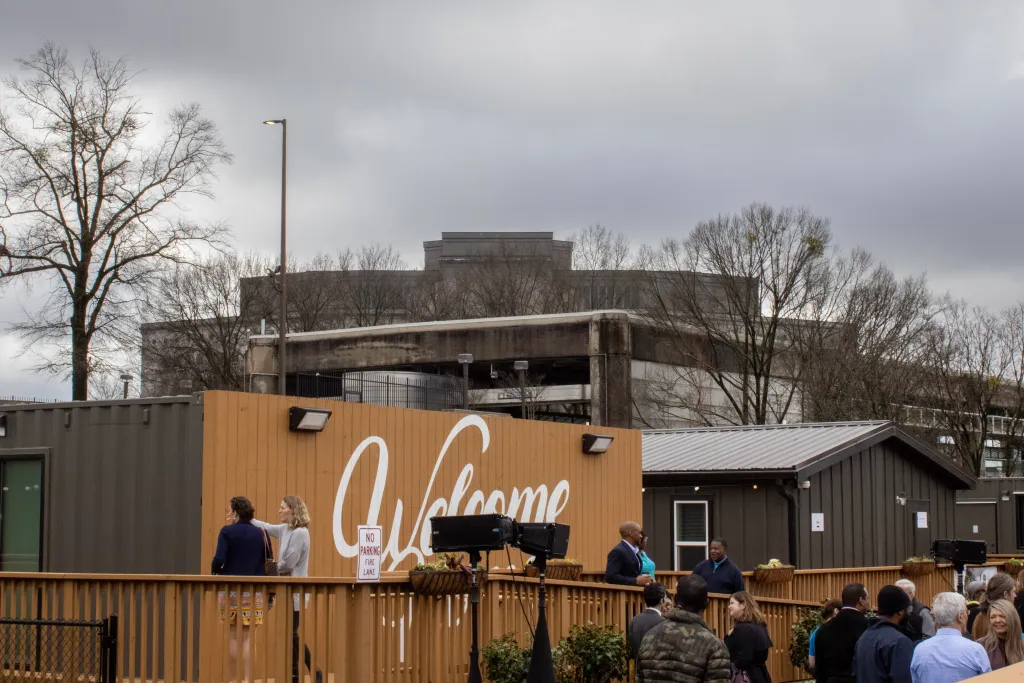
Deaths at The Melody raise concerns about Atlanta’s pilot shipping-container village for unhoused people
Three people have died at The Melody since the city opened the shipping-container apartment complex a year ago to rehouse chronically unhoused people.
That might sound like a lot for a community of just 40 people, but it’s an “unfortunate inevitability” for a population made up of chronically homeless people, according to Cathryn Vassell, the head of the city’s homeless services nonprofit, Partners For HOME.
“Unhoused individuals’ mortality is 30 years shorter than their housed counterparts,” said Vassell. “A big part of the challenge we face is that, by the time we get somebody into supportive housing, they might already be very sick — and while housing is a social determinant of health, there’s a lot of irreversible damage that we can’t change the course of.”
Atlanta Civic Circle visited The Melody to learn about the supportive services provided there — and to ask residents whether they felt they were receiving adequate care.
Some said they were satisfied with the assistance they receive from Hope Atlanta, a nonprofit that manages the complex and provides case managers and peer-support specialists to connect tenants to healthcare, mental health counseling, and other needed supportive services.
But others suggested that some residents require a closer eye as they navigate health challenges. “This is very sad, because no one was checking to make sure the residents are okay,” said Wanda Sutton, 61, one of The Melody’s first tenants. “There are sick people here, who don’t have family to check on them every day.”
That said, Sutton, a diabetic who uses a wheelchair, said she’s gotten ample assistance receiving the healthcare she needs, including help getting to her doctor appointments. The complex’s property manager, who asked not to be named, said she does her best to check on everyone daily. She said she’s the one who found each of the three tenants dead in their apartments.
As ACC investigated further, one thing became increasingly clear: This story was about the harsh realities of life for people who have spent years on the streets. That was the real system failure.
⇒ Tune in to WABE at 12:10 p.m. on Wednesday to hear ACC housing reporter Sean Keenan discuss this story.
HEARD ON HOUSING
Trump’s nominee for HUD secretary advances toward confirmation
Scott Turner, the former professional football player tapped by President Donald Trump to lead the U.S. Department of Housing and Urban Development, narrowly secured support from the Senate Banking Committee last week. His confirmation now hinges on a full vote from the Senate, which is expected to approve him along party lines.
More rapid-housing projects like The Melody are in the works
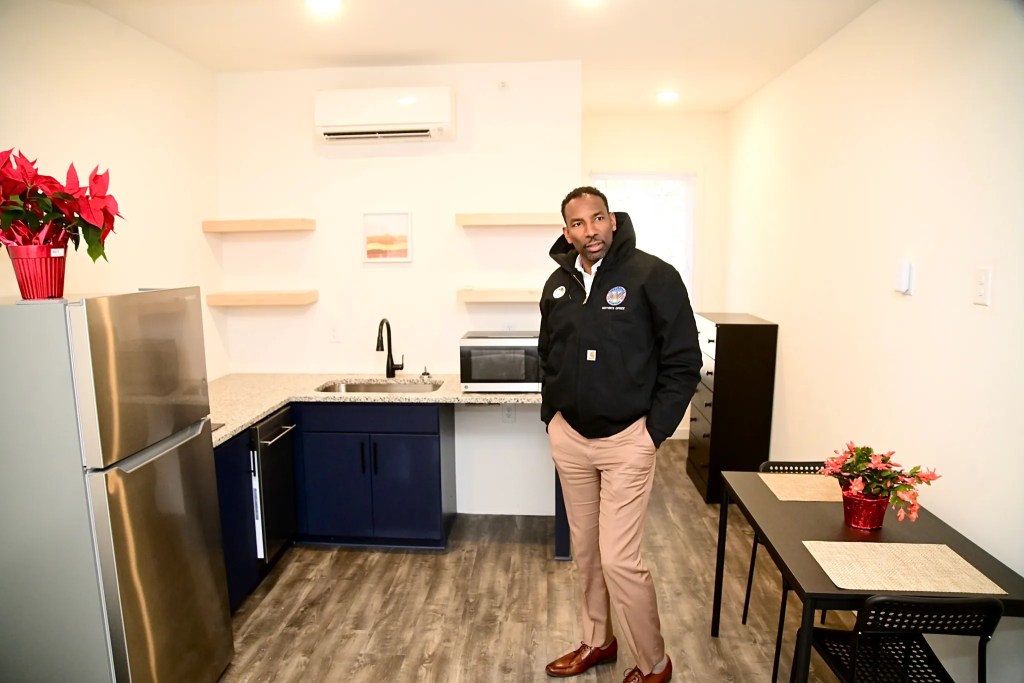
One year after the city of Atlanta kicked off its new rapid housing initiative with The Melody, located downtown at 184 Forsyth Street, the effort has produced 63 affordable apartments providing supportive services for people experiencing homelessness, with another 200 on the way.
But is the city on track to deliver its goal of 500 units by the end of 2025? Mayor Andre Dickens’ top policy advisor, Joshua Humphries, thinks so — but he said the city must still figure out where the remaining 237 units for the next phase will go.
After opening The Melody’s 40 shipping-container apartments in January 2024, the city closed out the year by cutting the ribbon on Bonaventure, a refurbished 23-unit apartment building in Virginia-Highland. Like The Melody, it offers fully furnished studio units for people who have been homeless for extended periods.
Up next: One-hundred apartments for unhoused people are under construction at a city-owned parcel near the corner of 17th Street and Northside Drive, just west of Atlantic Station.
The final 100 units for the first phase of the city’s rapid rehousing plan are slated to be part of a mixed-use, mixed-income development planned for 405 Cooper Street in Mechanicsville. For years, the cul-de-sac property was used as a homeless encampment.
Read more about the city’s rapid housing ambitions here.
Counting Atlanta’s unhoused population
Partners For HOME last night conducted its annual headcount of Atlanta’s unhoused population — a federally funded initiative called the Point in Time Count.
When the agency previously counted this demographic in January 2024, it identified 2,876 people experiencing homelessness — a 7% uptick from the prior year, when 2,679 people were tallied.
Atlanta Civic Circle joined Partners For HOME and volunteers on Monday night for the annual count. Stay tuned for a story on what we saw.
Today’s newsletter was written by Sean Keenan and edited by Meredith Hobbs.



Copyright (C) 2024 Atlanta Civic Circle. All rights reserved.
You are receiving this email because you opted in via our website.
Our mailing address is:
Atlanta Civic Circle
191 Peachtree Street, NE
#450, C/O Saba Long
Atlanta, GA30303
