


The Georgia Election Board on Tuesday passed a controversial new rule that expands county election boards’ powers to investigate vote tallies prior to certifying them — an unprecedented change to certifying elections in Georgia.
The rule, which the board’s Republican majority passed by a 3-2 vote, drew sharp rebukes from voting-rights groups and Democratic activists. They expressed concern that it could be weaponized by some county election board members who denied that President Joe Biden won the state’s 2020 presidential election.
That was just one of a flurry of proposed rules that the board considered in two, at times chaotic, full days of meetings on Tuesday and Wednesday. The State Election Board also drew criticism for engaging in rushed rule-making just 69 days before early voting begins on Oct. 15 for the high stakes presidential election on Nov. 5.
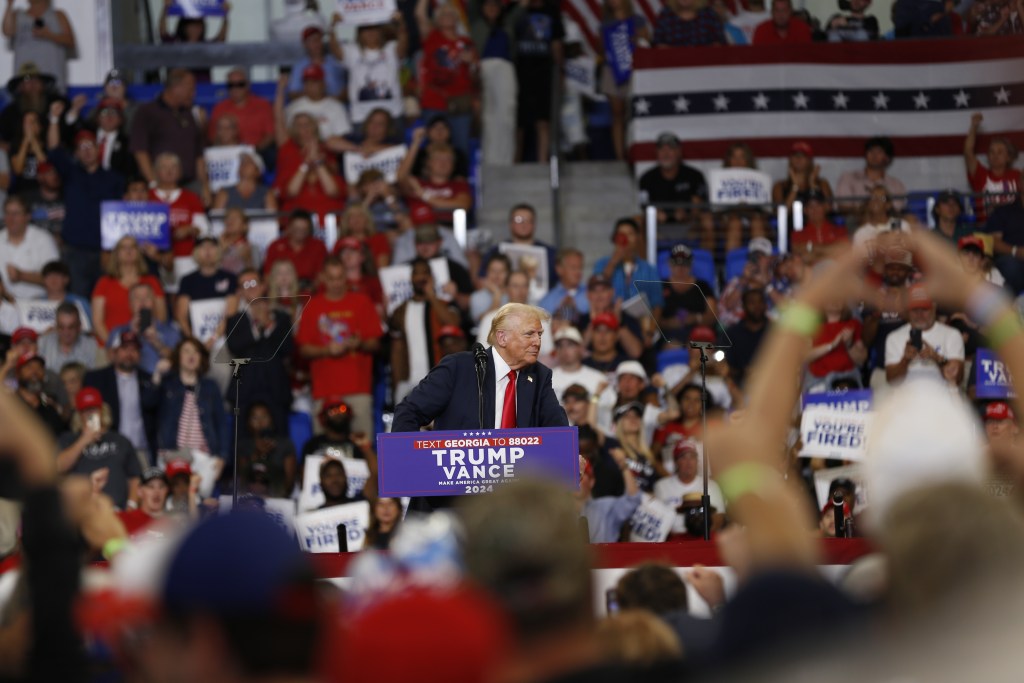
The three votes in favor of the new rule came from Republican board members whom former President Donald Trump praised as “pitbulls fighting for honesty, transparency, and victory” at his campaign rally in Atlanta last Saturday.
Those members are Janice Johnston, appointed by the state GOP and who attended Trump’s rally; Rick Jeffares, appointed by the GOP-controlled State Senate; and Janelle King, appointed by the GOP-controlled State House of Representatives.
Voting against the rule were the Democratic Party’s appointee, Sara Tindall Ghazal, and Republican Gov. Brian Kemp’s appointee, John Fervier, who chairs the board.
What is ‘reasonable inquiry’?
The new rule changes the definition for a county’s vote certification, stating that it “means to attest, after reasonable inquiry, that the tabulation and canvassing of the election are complete and accurate and that the results are a true and accurate accounting of all votes cast in that election.”
However, “reasonable inquiry” is not defined. Critics say the rule could be used to deny the certification of election results on little to no basis.
“This makes certification dependent on a board member’s personal perception of the accuracy of the election results,” said Kristin Nabers, the state director for All Voting Is Local, a voting rights advocacy organization. “What one person or one [county election] board considers reasonable inquiry could differ between boards …[in] 159 counties.”
The rule “provides board members cover to not certify elections where they don’t like the results,” she concluded.
The certification role for county election boards has historically been limited to attesting that the vote tally for each of their precincts is accurately reported and counted. County elections officials are directed to refer any suspicions of vote fraud or other irregularities to the county’s district attorney, said ACLU of Georgia’s director, Andrea Young.
“The law of Georgia has repeatedly confirmed that the role of election boards is administrative., iIt is not their role to conduct an inquiry,” she explained.
Critics were particularly concerned since a newly appointed Republican member of the Fulton County Election Board refused to certify primary election results in May. The board member, Julie Adams, belongs to an election denial activist group. (The other four Fulton board members, including one other Republican, did vote to certify the results.)
The rule appears to conflict with current state election law that says county elections officials “shall” certify election results by the Monday after an election.
Georgia’s Election Integrity Act of 2021 requires counties to certify the election results by 5 p.m. on the Monday after the election, as Secretary of State Brad Raffensperger pointedly stated Wednesday morning in a post on X. “We fully anticipate that counties will follow the law,” he said.

An ‘unprecedented’ board
Historically, the State Election Board’s rule-making has been a dry, bureaucratic process to offer guidance and standardization to how each county administers its elections.
“I’ve been going to state election board meetings for a couple of years, and until about a year ago, they used to be pretty boring … more than half the seats were empty,” said Nabers from All Voting Is Local.
The Republican-controlled state legislature passed a 2021 election law after Georgia went blue for the 2020 presidential and U.S. Senate elections that gave it new oversight powers over county election offices. The board subsequently targeted the Fulton Election Board for a drawn-out investigation.
The persistence of debunked claims that Trump won the 2020 election in Georgia, and new board members sympathetic to unsubstantiated claims of widespread fraud have radically shifted the State Elections Board’s approach to rule-making, said voting-rights advocates.
“All of this is really unprecedented,” said Young of the ACLU of Georgia. “We’ve never seen this kind of activity in the State Board of Elections.”
Creating chaos
The deluge of last-minute proposed rules before the board the summer before an election, Young said, is “an abuse of the system,” which creates an “impossible situation” for election administration.
Since Georgia Election Board rules don’t take effect until 40 days after they are passed, she added, some rules may not take effect until ballots are already printed and mailed out.
The Georgia ACLU, Young said, is “exploring options” for legal challenges to the new rule that gives county election boards more investigative discretion.
But that raises another problem, said Madeline Summerville, an attorney and Democratic political strategist. Even if such election rules clearly violate the law, a plaintiff only has what’s called “standing” to sue if they can show a rule would cause them harm.
And that likely wouldn’t happen until the election took place. “Establishing standing, especially at this stage, is going to be damn near impossible,” Summerville said.
More rules to come?
Several other proposed election rules that are still under consideration would change how poll workers are trained, how ballot drop boxes are regulated, and how absentee ballots are labeled.
Critics protested that these last-minute changes would incur substantial costs and create a nearly impossible task for county elections officials to execute in such a short timeline.
“I just want to make sure that we are walking with clear open eyes into the chaos that we are creating,” Ghazal, the board’s sole Democrat, said about one of the many rules that the board advanced at the Aug. 7 meeting, again by a 3-2 margin.
Adding to the potential electoral chaos is S.B. 189, a new law passed in the last legislative session, that opens the door for individual citizens to challenge the legitimacy of any voter’s registration.
The State Election Board will meet again on Aug. 19. Among other possible rule-making, it will resume discussion over appointing an election monitoring group for Fulton County.
One monitoring group under consideration is composed entirely of Republicans. One member, Heather Honey, has consulted for Cyber Ninjas, which pursued wild election conspiracies during a controversial audit of Arizona’s 2020 election – such as whether fraudulent ballots made with bamboo fibers came from China.
Leave a comment