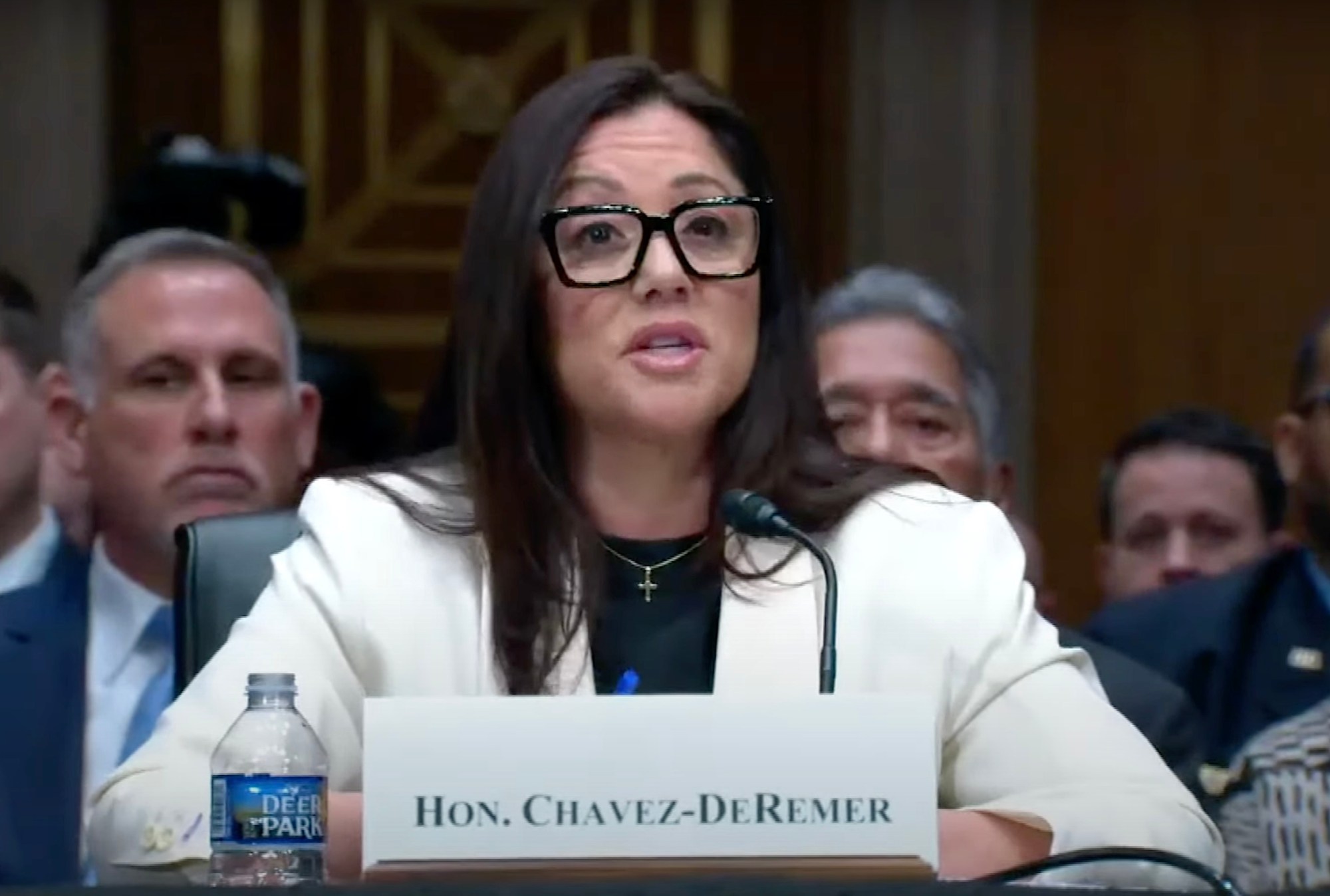
Lori Chavez-DeRemer, a former Republican Congressmember from Oregon, appears poised to become President Donald Trump’s labor secretary, following a nearly two-and-a-half-hour Senate confirmation hearing Wednesday.
Her nomination highlights a glaring contradiction of the second Trump administration: the tension between the anti-union billionaire donors — like Elon Musk — that back him and Trump’s appeal for the working class. Several unions, notably the Teamsters, backed Chavez-DeRemer’s nomination, even though most labor unions backed Trump’s Democratic opponent, Kamala Harris, in the presidential race.
Sen. Bernie Sanders (I-Vt.), the ranking member of the Senate Health, Education, Labor and Pensions Committee, addressed that tension head-on in his opening remarks at the Senate confirmation hearing.
“Will you be a rubber stamp for the anti-worker agenda of Elon Musk, Jeff Bezos, and other multi-billionaires who are blatantly anti-union […] or will you stand with working families all over the country?” Sanders asked.
“In my view we are moving towards an authoritarian society, where one person has enormous power. Will you have the courage to say: ‘Mr. President, that’s unconstitutional, that’s wrong’?” he asked.
Pro-union and ‘right-to-work?’
Hailed as a pro-union lawmaker, Chavez-DeRemer was one of the few Republicans who supported the Protecting the Right to Organize (PRO) Act, which would strengthen unions’ collective bargaining rights, and curtail employers’ ability to interfere with union organizing.
But Chavez-DeRemer backtracked on a key provision of the PRO Act that would overturn ‘right-to-work’ laws in 26 states, including Georgia, during her confirmation hearing. Among other provisions, those laws undercut labor unions by allowing workers employed in unionized workplaces to choose not to pay union dues.
“Do you still support the PRO Act?” Sen. Rand Paul (R-Ky.) asked.
“I fully, fairly support states who want to protect their ‘right-to-work,’” Chavez-DeRemer said. Paul pressed further, asking if she no longer supported the PRO Act’s measure to overturn right-to-work laws. “Yes,” she replied.
Even so, several unions, including the Teamsters and the Amalgamated Transit Union, endorsed Chavez-DeRemer for labor secretary. “We feel she has taken a middle road,” championing union and non-union workers alike, said Chuck Stiles, the political coordinator for Teamsters Local 728 in Atlanta.
Reacting to Chavez-DeRemer’s apparent change in stance on the PRO Act, Stiles replied, “We support the PRO Act, but then again we live in the real world.” Compromise is necessary, given the current political realities, he said, adding: “She’s working with who she’s working with.”
“She’s dealing with the cards she was dealt,” the Teamsters member said. “This was the grown up move. This is how you get things done.”
The Union of Southern Service Workers (USSW), which didn’t endorse a presidential candidate, urged Chavez-DeRemer to support raising the federal minimum wage from $7.25 per hour and to fight ‘right-to-work’ laws.
“We urge her to continue to champion legislation that eliminates ‘right-to-work’ laws, making it easier for workers, especially in the South, to join unions,” said USSW spokesperson and 30-year Waffle House server Cindy Smith.
“We need a labor secretary who will stand with unions and acknowledge that unions are the best path forward for all workers. Here in the South, where wages are lower than in the rest of the country, unions are especially critical,” Smith said.
But in her hearing, Chavez-DeRemer waffled on issues such as raising the federal minimum wage and paid family leave. “It’s not for me to decide – it’s for Congress,” she said about the federal minimum wage.
On paid family leave — which is provided by almost every country in the world — Chavez-DeRemer said: “I cannot say to you today that paid leave across the board should be something taken up by the federal government.”
Response to Trump, DOGE attacks on labor agencies
Trump’s rhetoric about workers appealed to many voters, winning him just over 40% of the union vote, compared with 51% of the nonunion vote, according to the Center for American Progress.
But since taking office, Trump has thrown federal agencies that safeguard labor rights into chaos. His unprecedented firings of the Democratic board members appointed by Congress to the National Labor Relations Board (NLRB) and the Equal Employment Opportunity Commission (EEOC) paralyzes both bodies, since they are now unable to form a quorum.
The NLRB oversees union elections and referees disputes between workers and employers, while the EEOC protects workers from workplace discrimination.
The two independent agencies are also facing constitutional challenges from Amazon CEO Jeff Bezos, in an effort to disband them. Musk has joined the litigation against the NLRB, while GOP attorneys general from over a dozen states have joined that against the EEOC.
Chavez-DeRemer declined to weigh in on those legal challenges at the hearing, but affirmed the “important work” and “independence” of the NLRB.
Senators also pressed her on reports that Musk’s Department of Government Efficiency (DOGE) has gained access to sensitive data at the Department of Labor and asked her about Trump’s mass firings of federal workers, which also affects the Department of Labor.
Chavez-DeRemer said she doesn’t know anything beyond what has been publicly reported. She said it would be a top priority, if confirmed, to be briefed on what DOGE is doing.
“I don’t know what’s been happening either,” she said.