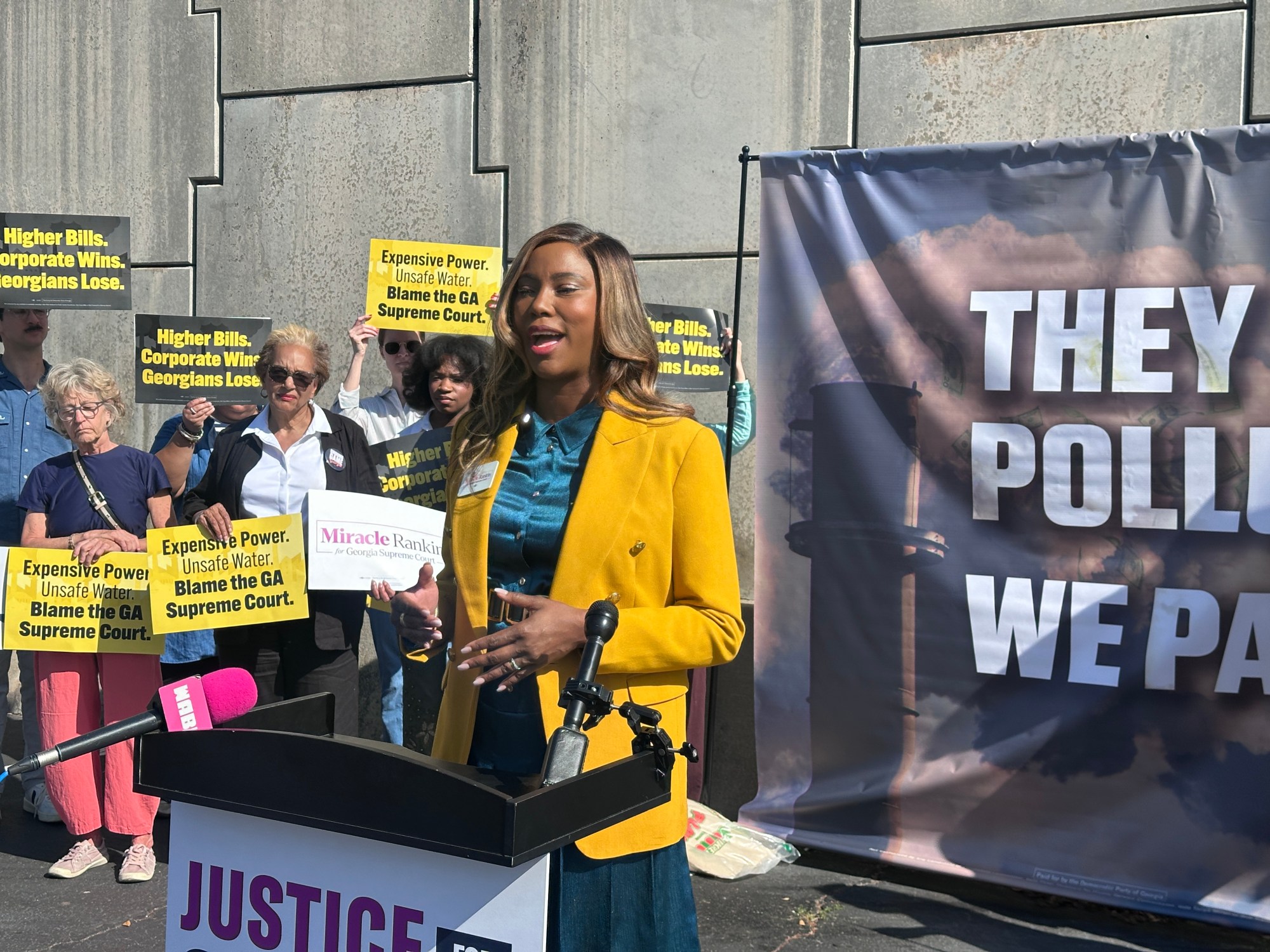
Upstart Georgia Supreme Court candidates Jen Jordan and Miracle Rankin said the state’s highest court isn’t serving the interests of working people at a Wednesday press conference in Mechanicsville.
That’s why the two, both personal injury lawyers, have mounted rare challenges to sitting state Supreme Court justices. Jordan is running against Justice Sarah Warren, while Rankin is running against Justice Charlie Bethel. Georgia’s nonpartisan judicial elections will be decided on May 19, as part of the statewide primary election.
“Our courts need to represent the people, not the powerful,” said Rankin at the press conference, where the two announced endorsements from a big labor union, Service Employees International Union (SEIU), its affiliate Workers United, and Georgia Conservation Voters.
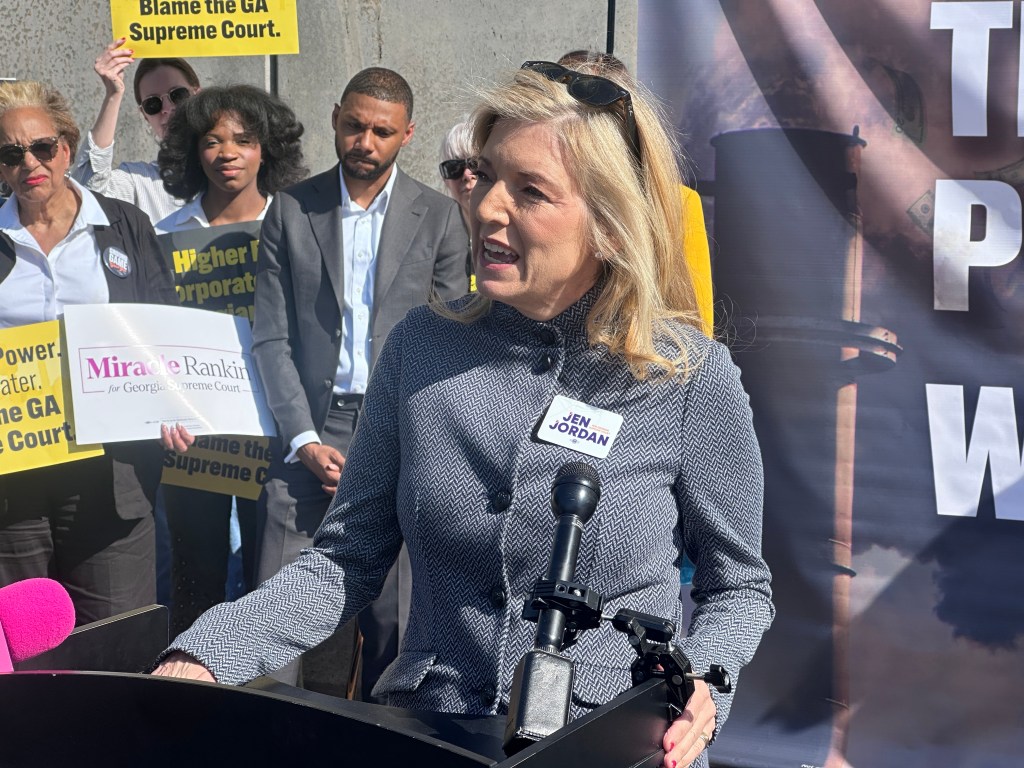
Jordan said her record shows she stands up for people. She pointed to her 2019 lawsuit against the Georgia Environmental Protection Division over its failure to alert the community about cancer-causing ethylene oxide emissions from Sterigenics, a Smyrna medical sterilizing plant.
Jordan added that Georgia courts too often side with big business over the people. For instance, she said, they allowed Georgia Power to pass on almost $9 billion in coal-ash cleanup costs to ratepayers. The Georgia Court of Appeals in 2021 ruled for Georgia Power after the Sierra Club sued — and the Georgia Supreme Court declined to hear the Sierra Club’s appeal.
“When folks think that maybe the Supreme Court doesn’t impact them, or the decisions don’t, all they have to do is actually look at their power bill and understand exactly how it does,” she said.
While Georgia judicial elections are officially nonpartisan, they are not free from partisan influence. The Democratic Party of Georgia is backing both Jordan, a former Democratic state senator for Decatur, and Rankin.
Conversely, Warren and Bethel were both appointed by Republican former Gov. Nathan Deal. Warren, appointed in 2017, was reelected in 2020 to a six-year term. Before Deal appointed him to the Supreme Court in 2018, Bethel served three terms as a Republican state senator for Dalton.
State courts matter more now
Individual rights are less likely to be protected at the federal level, Jordan and Rankin said, due to the Trump administration’s assaults and a conservative supermajority on the US Supreme Court. That means the Georgia Supreme Court must fill the gap, they said.
“A lot of our fundamental rights … are being pushed back to our state courts,” Rankin said. “Ultimately, our state courts are our last line of defense.”
“Folks aren’t able to go to the federal courts anymore for protection or for redress when it comes to harms. So, that necessarily means that we’re going to have to come to the state courts,” Jordan said. ”That’s not necessarily a bad thing, because Georgia’s Constitution actually provides those protections more than even the federal Constitution.”
“In Georgia, we often see profit put over working people,” said Chris Baumann, the regional director for the SEIU and Workers United. But working people don’t think they can turn to the Georgia Supreme Court or other state courts for redress, he added.
“You can’t go to those courts because it’s already locked down for corporations and profits,” Baumann said. ”We want to see a different world.”
Thoughts on RICO
Atlanta Civic Circle asked Jordan and Rankin for their thoughts on state prosecutors’ aggressive use of Georgia’s RICO law, one of the most expansive in the nation.
Jordan said she’s used the Georgia RICO law to pursue justice for clients, but she expressed concern about using it to suppress freedom of speech. For instance, Georgia Attorney General Chris Carr used the state RICO law to charge 61 alleged Stop Cop City protestors, which were later dismissed by a Fulton judge.
“I think that they have been used as a way to try to shut down differing opinions,” Jordan said. “The racketeering laws are supposed to be about going after the mafia, organized crime, that kind of thing. It is not supposed to be just because you don’t like what somebody is saying, or you don’t want certain protesters to show up and protest.”
“If such statutes are going to be used to go after individuals criminally, it has to be done with great caution,” Rankin added.
Fulton County District Attorney Fani Willis successfully used the state RICO law as a young prosecutor in 2014 against Atlanta Public Schools teachers over a cheating scandal. But as the Fulton DA, her RICO prosecution of alleged Young Slime Life gang members — the longest criminal trial in Georgia history — largely failed. And a Fulton judge ultimately dismissed her RICO case against President Donald Trump and 18 co-defendants over Trump’s unsuccessful attempt to overturn his 2020 election loss.
”Those prosecutions have failed, because they aren’t being used in the way that they’re supposed to be used,” Jordan said.
RICO cases use a lot of judicial resources — often at the expense of individual cases, at a time when staffing shortages are causing case backlogs. Jordan said there’s not much the Supreme Court can do to alleviate the backlogs, but that voters should consider the question when they next vote for their district attorneys.