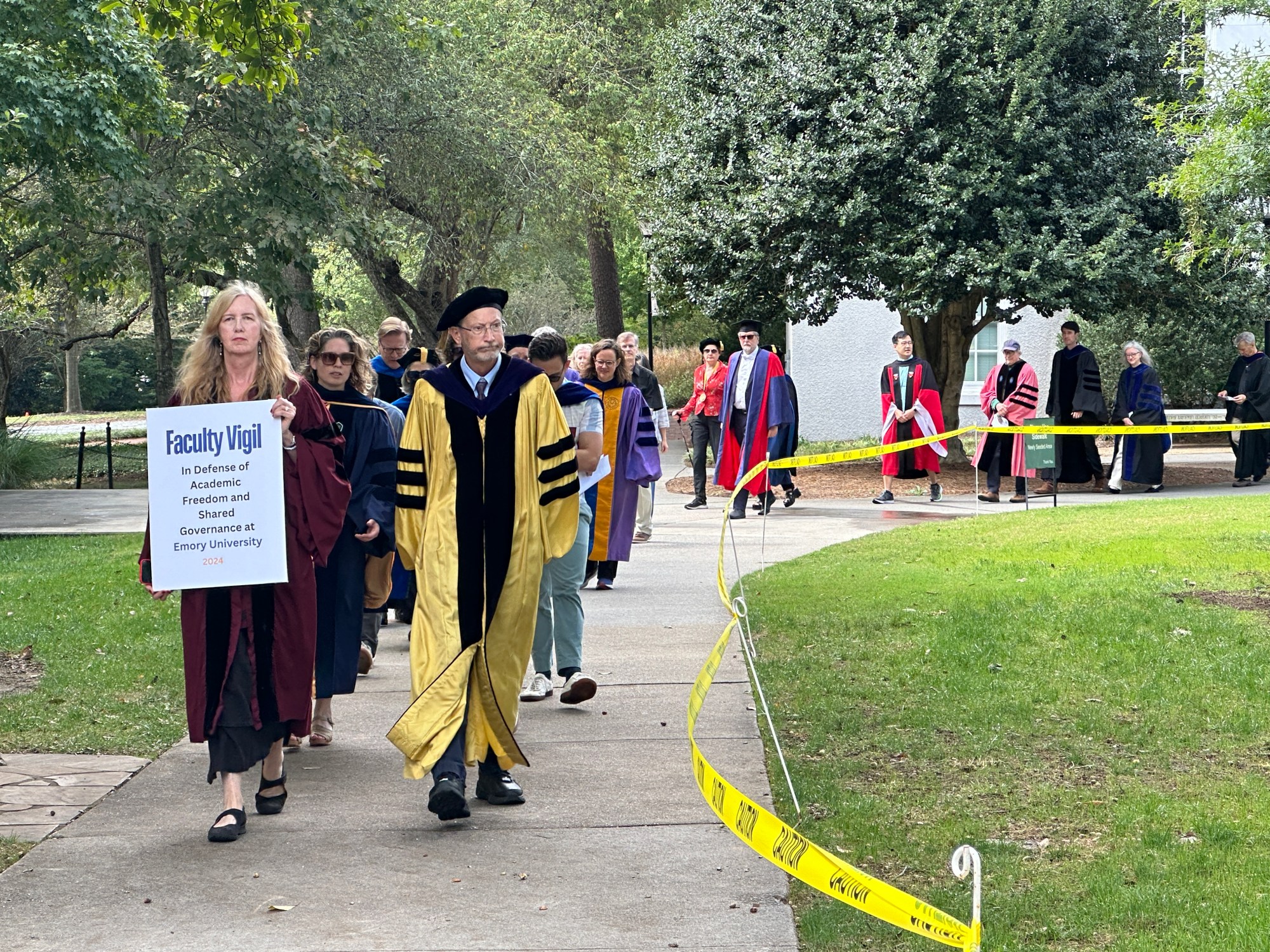
About fifty Emory University professors held a silent vigil Wednesday at noon to rebuke university president Gregory Fenves’ move to tighten the campus freedom of expression policy that governs protests.
The faculty, many dressed in their ceremonial robes, stood silently in front of Fenves’ office on the campus’s main quad, where the board of trustees was holding a regularly scheduled meeting, then marched a lap around the quad.
The solemn affair lasted about 30 minutes. Unlike a pro-Palestine student protest a week earlier, it was devoid of speechifying and chanting.
This wasn’t about the brutal war waged by Israel in Gaza against Hamas, which sparked a national wave of campus protests last spring. Instead, the participants said, it was about the Emory administration’s repressive response, as at many other universities, of calling in police to clamp down on free speech.
During Emory’s immediate crackdown on a pro-Palestine student encampment in April, police arrested 28 people, mostly students as well as three professors. Emory’s new campus expression policy bans encampments, prohibits demonstrations from midnight to 7 a.m. and bans occupying campus buildings.
The professors’ message to Fenves and the Emory administration was clear: You are silencing us.
The professors provided a statement at the Sept. 18 vigil that said they “stood in defense” of freedom of expression and a university governance partnership based on trust between students, administrators, and faculty.
“By word and deed, President Fenves has torn asunder these principles and practices. In so doing, he has tarnished the reputation and undermined the educational mission of Emory University,” the faculty statement concluded.
Emory’s College of Arts and Sciences faculty had already voted no confidence in Fenves last April, following the violent arrests. Fenves has refused to drop the misdemeanor charges against the students and faculty.
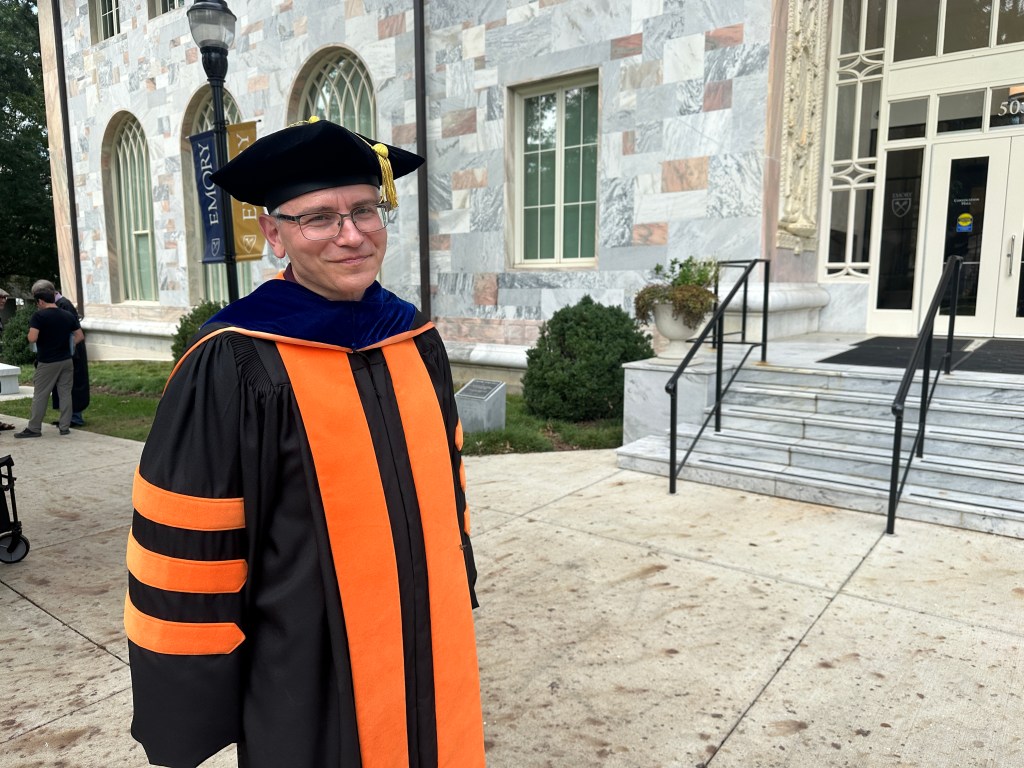
The chair of the faculty senate’s open expression committee, Ilya Nemenman, said Emory’s administration changed the rules without consulting his committee, which he called unprecedented. “Creating a policy without consultation is outside of the norm. They should have engaged the faculty” the biophysics professor said.
Chilling effect
The chilling effect of Emory’s policy change could already be felt. A few students passing by the protest told Atlanta Civic Circle that they were glad the faculty were standing up for them, but declined to be named for fear of doxxing or retribution.
One vigil organizer, gender studies professor Pamela Scully, said that most of the faculty demonstrating were tenured. She said a number of non-tenured faculty told her “that they couldn’t come because they were scared.”
Perhaps it was just a coincidence, Scully added, but caution tape cordoned off the quad’s lawn on Wednesday, with signs saying the grass had just been re-seeded.
Nemenman hopes the faculty’s protest action will place public pressure on the Emory administration to open a dialogue with them – but he said the faculty can’t require Emory to do that.
“The university is a corporation. It can be run by the chief executive the way he wants to do it,” he said, referring to Fenves.
An Emory spokesperson, reached for comment, said merely: “Emory supports peaceful expression as outlined in our policies” and directed a reporter to its statement on the new rules.