

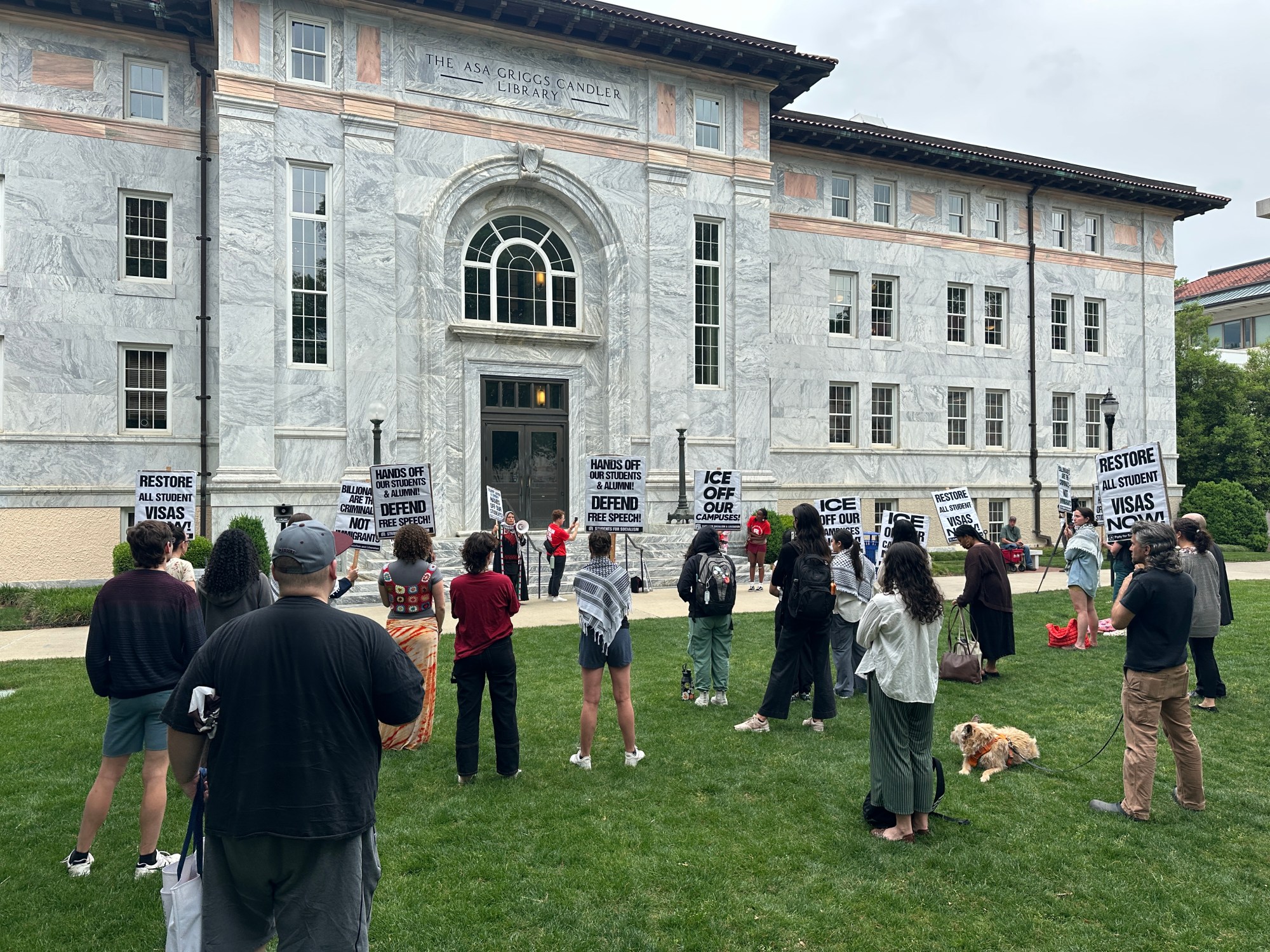
A year after law enforcement deployed tear gas against hundreds of peaceful pro-Palestine protestors on Emory University’s main quad, a few dozen student activists on Tuesday kicked off a week of action with teach-ins, art builds and more rallies.
The small crowd in front of Candler Library protested Emory’s ongoing charges against students and faculty arrested in last year’s sweep — and the Trump administration’s mass revocations of international students’ visas in an apparent effort to quell activism.
Of the 28 people arrested last year — including three faculty members — after Emory called in the Atlanta Police Department and Georgia State Patrol, DeKalb prosecutors have dropped criminal charges against only two. The Emory activists are demanding the university stop pressing charges against the remaining 26 students and faculty. As part of the week of action, they have scheduled a press conference in front of the DeKalb County Courthouse for Friday.
Asked if Emory will drop the charges, an Emory spokesperson referred questions to the DeKalb Solicitor’s Office. The solicitor’s office did not reply to a request for comment.
Last year, when law enforcement forcibly disbanded a peaceful pro-Palestine encampment on the main quad, students and staff quickly regrouped for more protests later that day, which continued over the following week.

The small size of Tuesday’s assembly was a marked contrast, reflecting the sense of fear that widespread arrests and the Trump administration’s deportation threats have instilled on university campuses.
“It has worked, unfortunately, the repression,” said Ibrahim, a student organizer with Emory Students for Justice in Palestine. He declined to give his last name for fear of doxxing or political retribution. “We don’t have the crowd we had a year ago.”
He attributed the smaller turnout to the police crackdown at Emory last year and the university administration’s subsequent changes to its free speech policy which include bans on encampments and demonstrations between midnight and 7 a.m.
The other significant factor, Ibrahim said, is the Trump administration’s recent barrage of visa revocations against foreign students whom it considers activists. Many students simply can’t risk their financial aid, visas, or doxxing, he said. “But we should not give up,” he added.
The U.S. State Department has revoked visas for at least four Emory students and alumni among almost 1,700 nationwide, as part of a broad effort to penalize social justice activists born outside of the United States. An Atlanta federal judge temporarily blocked 133 visa revocations, including 17 for international students in Georgia, but that hasn’t assuaged concerns among college demonstrators.
Emory theater professor Noe Montez said the same goes for faculty. “I have the protection of tenure, but that’s not true for others, like adjunct professors,” he said. ”The fear is a big depressant of turnout.”
Meanwhile, Georgia Tech students held a protest this afternoon against federal immigration authorities’ actions on campus and the revocations of “dozens” of student visas. But the stark reality was that the number of people who turned out to demonstrate was smaller than the number of students who reportedly had their visas revoked.
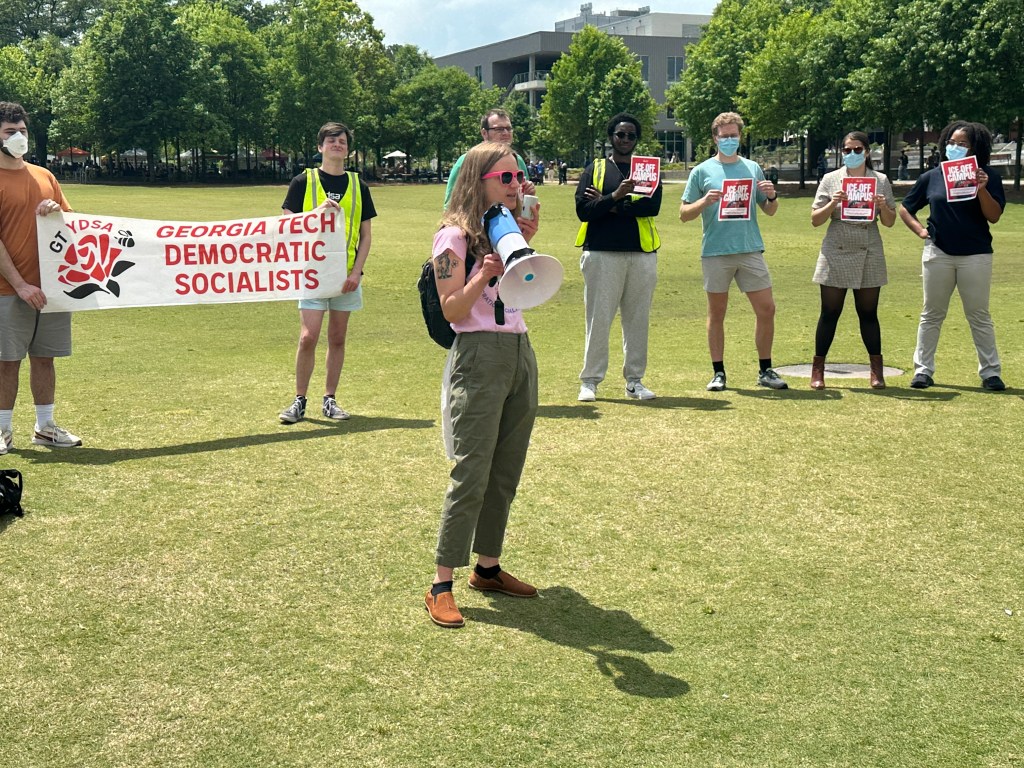
Fear is a factor for turnout, acknowledged one of the Georgia Tech organizers. “It will dampen turnout any time from now on. Students are concerned,” said Justin Bowen, a member of the Georgia Tech chapter of the Young Democratic Socialists of America.
“We need a lot more people fighting back, and we need to organize,” said one of the small rally’s participants, Kelsea Bond, a Democratic Socialist of America organizer who is running for Atlanta City Council. “The fear and intimidation is working, but we can’t be afraid,” Bond said.


Whether or not you agree with the cause, students should feel safe exercising their right to peaceful protest—especially at a university, where open dialogue is supposed to be encouraged.
The article really captured the shift in energy on campus. You can tell that the crackdown has had a chilling effect, and that’s just sad. I mean, it’s one thing to enforce rules or keep things orderly, but when the response to student voices is intimidation or arrests, it sends a pretty clear message about whose voices are welcome and whose aren’t.
What bothers me most is the inconsistency. Schools love to promote activism when it’s aligned with their image, but as soon as the message becomes controversial or inconvenient, suddenly it’s about “safety” and “policy.” Feels like selective support to me.